
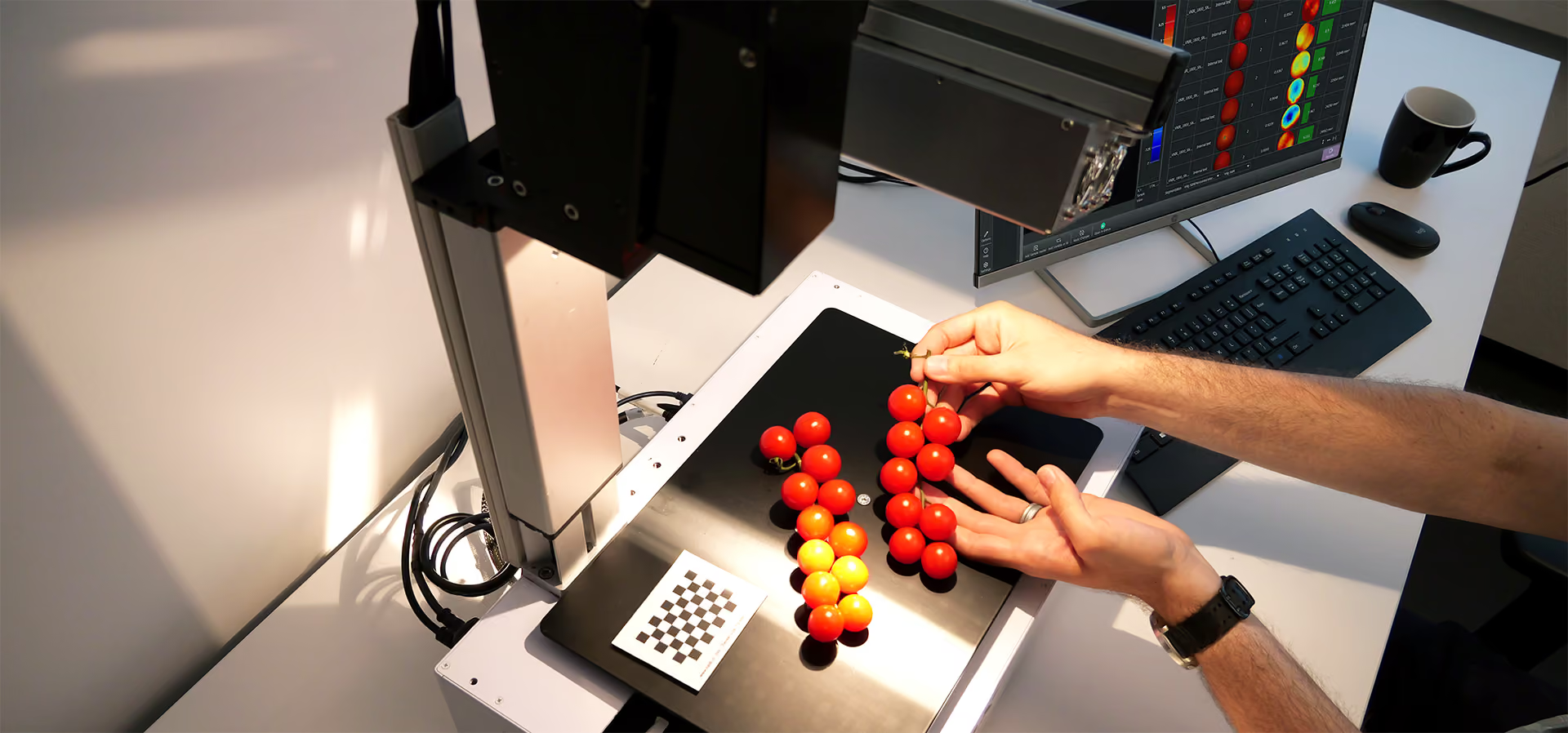

A spectral imaging system or hyperspectral imaging system is more than just a camera. It is the complete integrated platform — sensor, optics, electronics, software, and supporting hardware — that turns spectral measurement into a usable analytical or operational capability. Where individual components define what is technically possible, the system as a whole determines what is practically achievable in a real deployment.
This article looks at what defines a spectral or hyperspectral imaging system, how the major components fit together, what kinds of deployment configurations exist, and what factors should drive system selection for a specific application. It is intended for users who already understand the basic technology — covered in our overview of what hyperspectral imaging is — and want to think at the system level rather than the component level.
What Is a Spectral Imaging System?
A spectral imaging system is the complete set of hardware and software needed to acquire, process, and use spectral image data for a specific purpose. The term applies across the broader family of spectral imaging methods, including both multispectral and hyperspectral approaches. A hyperspectral imaging system is a particular type of spectral imaging system that uses dense contiguous spectral sampling to support deeper material identification and analytical work.
The distinction matters because the system requirements scale with the analytical ambition. A multispectral imaging system designed for general crop monitoring may require fewer components and lower precision than a hyperspectral imaging system designed for quantitative mineral mapping or research-grade biomedical work. Both are valid configurations — they just answer different questions and impose different design constraints.
In practice, "system" is often used loosely. Sometimes it refers to just the camera and its core electronics. More commonly, it refers to the complete integrated platform that a user would deploy in the field, laboratory, or industrial environment. This article uses the broader, more useful interpretation.
Core Components of a Hyperspectral Imaging System
Every hyperspectral imaging system is built around a handful of essential elements. Understanding what they do and how they connect is the foundation of evaluating any specific system.
The imaging sensor and spectrometer sit at the heart of the system. The sensor — the detector array — converts incoming light into electrical signal. The spectrometer disperses incoming light into its wavelength components before it reaches the detector. Together they form the measurement core. Our overview of hyperspectral sensors covers the detector layer in detail; our imaging spectrometer article covers the dispersive optical instrument.
The fore optics include the lenses and optical accessories that shape how the system sees its subject — selecting the field of view, working distance, and image scale appropriate for the application. Different applications need different fore optics, which is why most hyperspectral systems support multiple lens options.
The acquisition electronics include the data acquisition unit, the computing platform, the cabling and interfaces, and the synchronization hardware that connects the sensor to storage and control systems. Modern systems often include integrated touch-screen interfaces and standardized connection options.
The calibration components include light sources, reference targets, dark current calibration mechanisms, and the calibration data shipped with the system from the factory. Without proper calibration, raw sensor signal cannot be turned into meaningful measurements.
The positioning and motion hardware depends on the deployment context. Airborne systems include IMU and GPS units for georeferencing. Laboratory systems include translation and rotation stages for controlled scanning. Industrial systems use conveyor belt motion. UAV systems combine compact navigation systems with platform integration.
The software stack includes acquisition software, calibration and correction tools, visualization and analysis platforms, and the integrations needed to feed results into downstream workflows. HySpex cameras across the Classic, Mjolnir, and Baldur families are also delivered with a high-end SDK and library that simplifies integration with third-party software and hardware — important for industrial users building custom pipelines or for research teams embedding hyperspectral capability into existing analytical frameworks. Our overview of hyperspectral software covers the software layer in more depth.
How Components Fit Together
A useful way to think about a hyperspectral imaging system is as a chain that must be balanced across all its links. A high-quality sensor connected to poor optics will be limited by the optics. A well-calibrated camera mounted on a vibration-prone platform will suffer in real deployment. Excellent hardware feeding software that cannot handle the data volume becomes operationally useless.
This is why scientific-grade system providers focus on the integrated platform rather than any single component. The HySpex product range, for example, organizes around three camera families — HySpex Classic, HySpex Mjolnir, and HySpex Baldur — but is delivered as complete configured systems rather than as bare cameras. The supporting hardware, calibration, and software are all part of what makes the system functional.
For users evaluating spectral imaging systems, this means that comparing component-level specifications is necessary but not sufficient. The integration quality, calibration traceability, software maturity, and supporting service ecosystem matter at least as much as the headline numbers on a camera datasheet.
Deployment Configurations — How Systems Are Built for Specific Environments
A particular hyperspectral imaging system is shaped by where it will operate. The same underlying camera technology can be packaged very differently for different environments. HySpex organizes its complete systems into five standard turnkey configurations, each tuned to a specific operational context.
Laboratory systems integrate the camera with translation stages, lab racks, full-range light sources, and acquisition software for controlled scanning of static scenes. Working distances range from a few centimeters to infinity, supported by close-up lenses for different sample sizes. The Laboratory Systems configuration is suited to research, materials analysis, biomedical investigation, and any context where samples can be brought to the system rather than the other way around.
Field systems are designed for outdoor scientific work, combining cameras with tripods, rotation stages, battery-powered acquisition units, and portable accessories. Multiple tripod and rotation stage options support different operational scenarios — from terrain mapping to mine face scanning. The Field Systems configuration is the workhorse for in-situ research and exploration applications.
Airborne systems are complete integrated platforms for aircraft deployment, with IMU/GPS navigation systems, high-performance rack computers, vibration-damped mounts, and dedicated airborne software. The Airborne Systems configuration is used for wide-area mapping, environmental surveys, and large-area scientific work.
UAV systems package the technology for drone deployment, built around the compact HySpex Mjolnir series. The UAV Systems bundle combines the camera with an onboard computer and an Applanix navigation system in a single self-contained module. The Mjolnir is positioned as a generic payload that can be integrated onto any UAV with sufficient lift capacity, providing scientific-grade hyperspectral data with the operational flexibility of drones.
Industrial systems combine the HySpex Baldur series with Prediktera Breeze Runtime software for real-time material sorting, contamination detection, and quality control on production lines. The Industrial Systems configuration provides NIST and PTB-traceable calibration, external triggering (TTL, LVDS), and the integration paths needed for inline deployment.
For applications that fall outside these standard configurations, Custom Solutions provide bespoke system design. Examples include the HySpex Core Scanner for drill core analysis, the HySpex Art Scanner originally developed for the Louvre's C2RMF, the HySpex Fish Quality Analyzer for seafood inspection, the HySpex Phenotyper for plant research, and the HySpex Mjolnir IP65 for unattended outdoor monitoring.
System Integration and the Broader Workflow
A hyperspectral imaging system rarely operates as an isolated capability. In most real deployments, it sits within a broader workflow that includes data storage, processing, analysis, decision-making, and integration with other systems. The integration quality at these boundaries often matters as much as the imaging system itself.
For airborne and UAV systems, integration includes navigation system synchronization, platform mounting, vibration damping, and downstream processing through tools such as PARGE for geometric correction and ATCOR-4 for atmospheric correction. The integrated processing chain from raw signal to surface reflectance is covered in our overview of hyperspectral image data.
For industrial systems, integration includes synchronization with conveyor belt motion, communication with sorting actuators, integration with manufacturing execution systems, and connection to quality control databases. The Prediktera Software Suite provides the runtime layer that connects acquisition to operational decisions.
For laboratory and research systems, integration includes data export into analytical platforms, integration with sample handling, and workflows for building and validating spectral libraries. Real-time processing platforms such as HySpex Bifrost are increasingly important for applications where decisions are needed during acquisition rather than after.
In all of these contexts, the workflow is what turns a working camera into a useful system. Scientific-grade hyperspectral system providers spend significant engineering effort on the integration boundaries — and that effort is often what distinguishes a system that works in the field from one that only works on a bench.
Evaluating a Spectral or Hyperspectral Imaging System
Choosing the right system involves more than picking the camera with the most pixels or the most bands. Several considerations consistently shape the decision.
Application fit is the first question. What does the system need to measure, classify, identify, or quantify? Different applications have different spectral range, sensitivity, throughput, and resolution requirements. A system designed for general remote sensing may be poorly suited to detailed mineralogical analysis, and vice versa.
Spectral and spatial requirements follow from the application. The spectral range needed (visible, NIR, SWIR, thermal), the spectral resolution required to resolve target features, the spatial resolution and field of view appropriate for the working distance — all of these need to be matched to the application rather than maximized abstractly.
Calibration stability and traceability matter for any application where results need to be compared across instruments, sites, or time. Scientific-grade systems provide traceability to standards such as NIST and PTB; less rigorous systems may not. This becomes critical for longitudinal monitoring or quantitative work.
Deployment fit is what makes a system actually usable in the intended environment. A laboratory-grade system mounted on a drone will not perform well. A compact UAV system used in a production environment may lack the calibration stability and integration needed.
Software and analytical capabilities determine whether the data can be turned into the answers the application requires. Hardware that produces beautiful data but feeds into inadequate analytical software is not useful.
Long-term support matters because hyperspectral systems are typically long-term investments. The ability to maintain calibration services, source spare parts, and support evolving requirements over a system's lifecycle is part of what users are buying.
The HySpex Key Quality Parameters resources and the HySpex Buyer's Guide cover these considerations in more depth.
The Architecture Choice — Pushbroom and Beyond
One architectural choice deserves particular attention because it shapes everything that follows: the acquisition method. Most scientific-grade spectral imaging systems use a pushbroom architecture, where one spatial line and the full spectrum for that line are captured at each moment, with the second spatial dimension built up through relative motion between the sensor and the scene.
HySpex builds its complete system range — Classic, Mjolnir, and Baldur — around pushbroom acquisition because of the data quality advantages: high spectral and spatial resolution, well-controlled optical performance, strong signal-to-noise ratio, and calibration stability over years of use. Alternative architectures such as snapshot hyperspectral cameras trade data quality for instantaneous capture and have their own use cases, but they are typically not the foundation for demanding scientific or industrial applications.
For users evaluating spectral imaging systems, understanding this architectural choice is one of the most important early decisions. It shapes the kinds of applications the system can support and the kinds of data quality it can deliver.
The System as a Long-Term Investment
A hyperspectral imaging system is typically a multi-year investment that supports scientific work, industrial production, or operational missions over an extended period. The right system is the one that fits the application today and continues to fit it as requirements evolve.
This is why scientific-grade providers emphasize stability and supportability alongside performance. HySpex has built hyperspectral systems since 2003 and reports that none of its products have reached end of life — a continuity that matters significantly for users building long-term analytical infrastructure around their hyperspectral capability.
For organizations evaluating spectral or hyperspectral imaging systems for the first time, the most useful starting question is not "what is the best system" but "what is the right system for our specific application, deployment, and analytical goals". That question is what serious system selection comes down to.
Discuss a Spectral or Hyperspectral Imaging System for Your Application
Selecting the right spectral imaging system or hyperspectral imaging system depends on the application requirements, the deployment environment, the analytical workflow, and the long-term support needs. Different combinations of camera, accessories, software, and integration support shape what is possible in a real deployment.
HySpex develops scientific-grade hyperspectral imaging systems delivered as complete configured solutions — from turnkey deployments for laboratory, field, airborne, UAV, and industrial environments through to custom solutions for specialized applications. If your project involves spectral imaging system design, specification, or deployment planning, a technical discussion about your specific requirements is often the best starting point. Feel free to contact us for more information.
FAQ – Spectral and Hyperspectral Imaging Systems
What is a spectral imaging system?
A spectral imaging system is the complete set of hardware and software needed to acquire, process, and use spectral image data. It includes the sensor, optical components, electronics, calibration mechanisms, supporting hardware (mounts, navigation, illumination), and software. The term covers both multispectral and hyperspectral configurations.
What is a hyperspectral imaging system?
A hyperspectral imaging system is a spectral imaging system that uses dense, contiguous spectral sampling — typically hundreds of narrow wavelength bands — to support detailed material identification and quantitative analysis. It includes the same core components as any spectral imaging system but is designed for higher spectral fidelity.
What components make up a hyperspectral imaging system?
The core components include the imaging sensor and spectrometer, fore optics, acquisition electronics, calibration components, positioning or motion hardware appropriate to the deployment (IMU/GPS for airborne, translation stages for laboratory, conveyor integration for industrial), and the software stack for acquisition, processing, and analysis.
How is a spectral imaging system different from just a camera?
A camera is the integrated optical and electronic unit that captures the data. A system includes the camera plus everything needed to use it productively in a specific environment — mounts, navigation, software, calibration, supporting infrastructure. For most real applications, the system perspective is what matters.
What deployment configurations exist for hyperspectral imaging systems?
HySpex offers five standard turnkey configurations — Laboratory, Field, Airborne, UAV, and Industrial — each designed for a specific operational environment. Custom solutions are developed for applications outside these standard configurations, such as the HySpex Core Scanner for drill core analysis and the HySpex Art Scanner for cultural heritage conservation.