
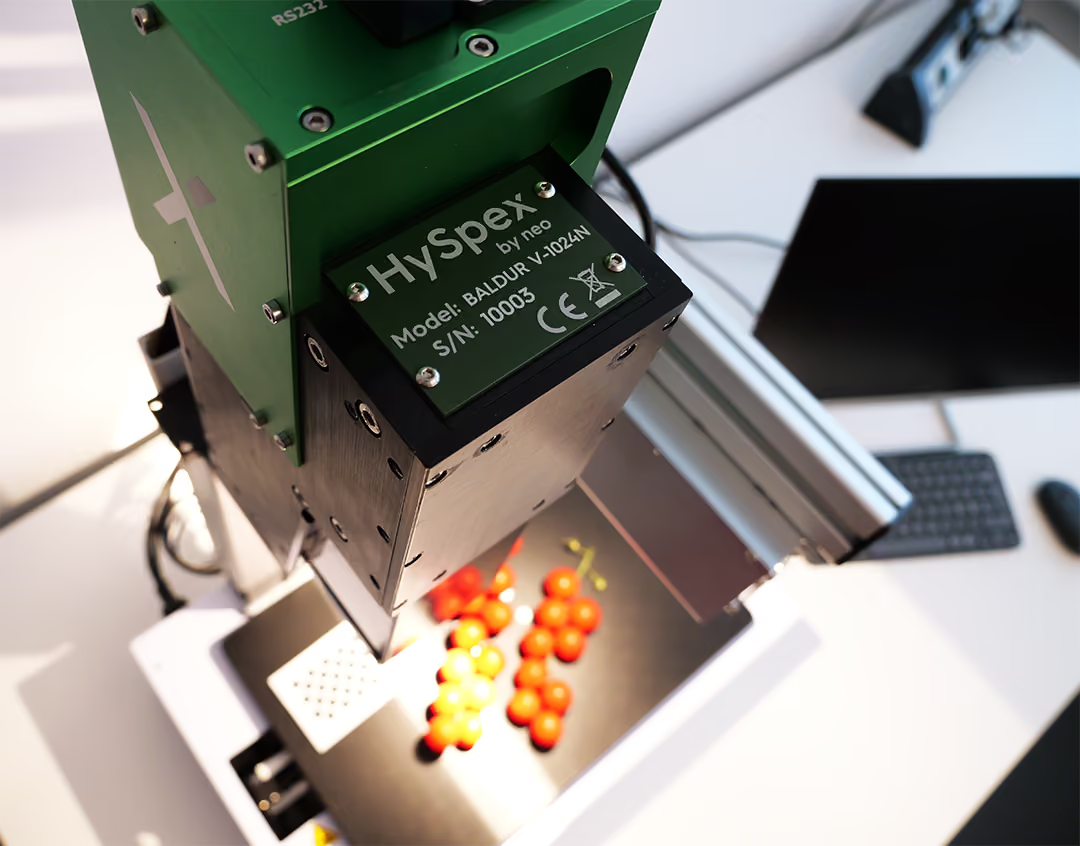

A snapshot hyperspectral camera is one of several ways to capture hyperspectral data, and the choice of acquisition method has a direct impact on data quality, system complexity, and the kinds of applications a hyperspectral camera is suited for. As hyperspectral imaging expands into more fields — from industrial inspection and UAV remote sensing to scientific research and defense — understanding the differences between snapshot, pushbroom, and whiskbroom systems has become an important part of selecting the right tool for the job.
This article looks at how these three acquisition methods work, where each one performs best, and why scientific-grade hyperspectral imaging continues to rely heavily on pushbroom architectures for the most demanding applications.
What Is a Snapshot Hyperspectral Camera?
A snapshot hyperspectral camera captures both spatial and spectral information from a scene in a single exposure, without requiring scanning motion. Where a traditional scanning system builds up a hyperspectral image line by line or point by point, a snapshot system records the full data cube — every spatial pixel and every spectral band — at once.
This is achieved through several different optical and sensor architectures, including spectral filter arrays (similar in concept to a Bayer pattern but with many more bands), tunable filters, image-mapping spectrometers, and computed tomography imaging spectrometry. The common feature is that the data is acquired instantaneously rather than sequentially.
The appeal is straightforward. A snapshot camera can image moving or dynamic scenes without motion blur, does not require external scanning hardware, and is often more compact than scanning alternatives. For applications where the scene changes rapidly or the platform cannot provide stable scanning motion, those advantages can be decisive.
The Three Main Hyperspectral Acquisition Methods
Most modern hyperspectral systems fall into one of three acquisition architectures, each with distinct strengths and trade-offs.
Snapshot systems capture the full hyperspectral data cube in a single exposure. They sacrifice spatial and spectral resolution in order to gain temporal performance.
Pushbroom systems use a linear array of detectors and rely on relative motion between the sensor and the scene — either the platform moves (in airborne or UAV deployment) or the scene moves past a stationary sensor (on a conveyor belt or under a translation stage). One spatial line and the full spectrum for that line are captured at each moment, and adjacent lines are assembled into the full image cube.
Whiskbroom systems use a single detector or a small array, scanning across the scene one pixel at a time using a moving mirror or other mechanism. They were historically common in early Earth observation systems but are less prevalent in modern hyperspectral imaging.
Each architecture represents a different trade-off between speed, resolution, and data quality — and that trade-off is what determines which method makes sense for a given application.
Snapshot Imaging: How It Works
A snapshot hyperspectral camera records all spatial and spectral information in a single acquisition by spreading the data cube across the available detector area. Because a two-dimensional detector cannot natively store three-dimensional data (two spatial dimensions plus one spectral dimension), snapshot architectures must split that cube in some way across the sensor surface.
Several approaches are used in practice:
- Spectral filter arrays place tiny bandpass filters in front of individual detector pixels, with different filters tuned to different wavelengths. Each pixel records one band, and the full hyperspectral image is reconstructed from the mosaic.
- Image-mapping spectrometers physically rearrange the scene onto the detector so that different spatial regions are dispersed into spectra.
- Tunable filter systems capture multiple bands in rapid succession by sweeping a filter, which is technically not a true snapshot but is often grouped with them in practice.
- Computed tomography imaging spectrometers use diffractive optics combined with reconstruction algorithms to recover the data cube from a single exposure.
The advantages of snapshot imaging follow directly from the architecture. There is no scanning motion required, so dynamic or unstable scenes can be imaged without smear. The system can be physically compact, which is attractive for handheld or constrained platforms. And the acquisition is essentially instantaneous, which simplifies certain workflows.
The disadvantages are equally direct. Because the detector has to encode three dimensions of information into two, either spatial resolution, spectral resolution, or both must be compromised compared with what the same detector could deliver if it were used for a scanning system. Snapshot systems typically offer fewer spectral bands, wider band widths, and lower spatial resolution than scientific-grade scanning systems. Signal-to-noise ratio is often lower because the available light is divided across the encoded dimensions. And the reconstruction step can introduce artifacts that affect quantitative analysis.
For applications where speed and motion tolerance matter more than absolute data quality, those trade-offs are entirely acceptable. For applications where spectral and spatial fidelity drive the value of the data, they often are not.
Pushbroom Imaging: How It Works
A pushbroom hyperspectral camera uses a two-dimensional detector array more efficiently. At each moment, the system images a single spatial line of the scene through a narrow slit. The light from that line is then dispersed by a diffraction grating or prism, projecting a full spectrum for every spatial position across the detector. One detector dimension records spatial position along the line, and the other records wavelength.
As the platform or the scene moves, successive lines are recorded and assembled into a complete hyperspectral image cube. The motion provides the second spatial dimension, which is why pushbroom systems are sometimes described as "line-scan" or "scanning" architectures.
This approach has significant advantages for data quality. Because the full sensor area is dedicated to one spatial line and its full spectrum, spectral resolution and spatial resolution can both be high. A modern scientific-grade pushbroom system can deliver hundreds of contiguous narrow bands across the visible, near-infrared, and shortwave infrared with strong signal-to-noise ratio and well-controlled optical performance. Calibration can be carefully managed across the linear field of view, and consistent imaging quality can be maintained over years of use — which matters enormously for scientific and long-term monitoring applications.
The trade-off is that pushbroom systems require relative motion. In airborne and UAV deployment, this is provided naturally by the platform. In laboratory and field setups, it is provided by translation or rotation stages. In industrial applications, it is provided by the conveyor belt carrying the material. For most use cases, this is a non-issue, but for static observation of dynamic scenes from a stationary platform, pushbroom is not the right choice.
When Does Snapshot Make Sense?
Snapshot hyperspectral cameras are a legitimate and useful technology — not a compromised version of pushbroom. They are simply optimized for different conditions.
A snapshot hyperspectral camera is often the right tool when:
- The scene is dynamic and cannot be reliably scanned without motion artifacts
- The platform cannot provide stable scanning motion
- High temporal resolution matters more than spectral or spatial detail
- A compact, integrated camera is required without external scanning hardware
- The application can tolerate fewer bands and lower resolution in exchange for instantaneous capture
- Real-time monitoring of fast processes is the primary goal
Typical use cases include certain medical and biomedical imaging applications, security and surveillance scenarios with moving targets, and some forms of UAV imaging where the platform cannot fly a stable scanning trajectory.
When Does Pushbroom Win?
For applications where the value of hyperspectral imaging depends on the quality of the spectral data — not just its presence — pushbroom is typically the right architecture.
Scientific research depends on calibrated, repeatable, high-resolution spectral data. Mineral exploration and hyperspectral imaging in mining require subtle absorption features to be detected and mapped accurately, often in the shortwave infrared where snapshot systems perform poorly. Defense and surveillance applications demand calibration stability and signal-to-noise ratio that scientific-grade pushbroom systems are built to deliver. Airborne and UAV remote sensing rely on the inherent platform motion to provide scanning, making pushbroom the natural choice. Industrial sorting and process monitoring use the conveyor motion as the scan dimension, and benefit from the high throughput and spectral fidelity that pushbroom delivers. Laboratory analysis, where translation stages provide controlled scanning, gives pushbroom systems an ideal operating environment.
In all of these cases, the limitations of snapshot architectures — fewer bands, wider band widths, lower resolution, lower SNR, potential reconstruction artifacts — become real obstacles to extracting reliable information from the data. The acquisition method directly shapes what the data can be used for.
Quality Considerations Beyond Acquisition Method
Acquisition architecture is one factor, but it is not the only one that determines how good a hyperspectral system is. Several other parameters matter just as much, and they apply across both snapshot and scanning systems.
Spectral fidelity — how accurately the system measures the true spectrum at each pixel — depends on optical design, calibration, and stability. A nominal band count is not the same as a useful band count if the bands overlap, drift, or carry significant noise.
Optical distortions such as smile (band-to-band misalignment along the spatial dimension) and keystone (spatial misregistration across spectral bands) can significantly degrade data quality. Scientific-grade pushbroom systems typically control these distortions to a small fraction of a pixel.
Point spread function (PSF) and Nyquist sampling govern how well the optical system resolves spatial and spectral features. A system that under-samples its own PSF will look sharp on paper but lose information in practice. HySpex covers these considerations in detail in its Key Quality Parameters resources.
Calibration traceability is essential for any application where data must be compared across instruments, sites, or time. Without it, "hyperspectral data" is just numbers.
Signal-to-noise ratio determines how well subtle features can be distinguished from sensor noise — especially important in applications such as mineral exploration, where the difference between two related minerals may rest on a small absorption feature.
These factors apply to every architecture. A pushbroom system with poor calibration is not better than a well-designed snapshot system. But a scientific-grade pushbroom system, properly engineered and calibrated, generally delivers more usable information per measurement than a snapshot equivalent.
Why HySpex Builds Pushbroom Systems
At HySpex we made a deliberate architectural choice. Every camera in the HySpex Classic, Mjolnir, and Baldur families uses a pushbroom architecture, and the company has been transparent about why — including in technical writing that directly addresses the question of why HySpex does not offer snapshot cameras.
In the recent EDA Hyper-IP defense project announcement, HySpex stated plainly that "all our cameras use a pushbroom system — we believe this is the go-to architecture for creating high-quality hyperspectral systems." This is a conscious decision driven by spectral fidelity considerations: pushbroom systems have spatial and spectral misregistration of less than 10% of a pixel, and misregistration in those dimensions is one of the largest contributors to degraded spectral data quality. That position reflects more than thirty years of electro-optical research at NEO (Norsk Elektro Optikk), the parent organization behind HySpex, and a deep commitment to data quality over architectural novelty.
What is interesting is that HySpex is also exploring non-pushbroom approaches in specific research contexts. The Hyper-IP project itself involves a novel hyperspectral technique outside the pushbroom architecture, used to evaluate what data quality can be achieved with alternative methods. That kind of honest investigation — rather than blanket advocacy — is what serious instrument design looks like. The default architecture for HySpex products remains pushbroom because that is what delivers the spectral and spatial fidelity required by the company's scientific, industrial, and remote sensing customers.
Why HySpex Calls Pushbroom the True Snapshot
An interesting argument that HySpex has made about its architectural choice frames pushbroom systems as the real snapshot hyperspectral cameras. The reasoning is that for any pushbroom acquisition, the camera captures the full spectrum for an entire spatial line in a single exposure — a true snapshot of the two dimensions that matter most for spectral fidelity: spatial position along the line, and full wavelength coverage at every point along that line.
The third dimension — the second spatial axis — is then built up through scanning motion, which platforms such as aircraft, UAVs, conveyor belts, and laboratory translation stages provide naturally. Under this framing, what is typically called a "snapshot" hyperspectral camera is actually trading spectral and spatial fidelity to acquire a less complete data product in a single exposure. Snapshot systems compress the full data cube into one shot through filter arrays or interferometric techniques, accepting lower band counts, reduced spectral resolution, and weaker signal-to-noise ratio as the cost.
Pushbroom systems, by contrast, take a higher-fidelity snapshot of what matters most — the spectral signature of every pixel along a spatial line — and assemble the full image through motion that is already present in most operational scenarios. The argument is not that snapshot architectures have no place, but that for serious analytical work where spectral fidelity is the primary requirement, the pushbroom approach delivers a more useful "snapshot" of the information that actually drives material identification and analysis.
Choosing the Right Hyperspectral Camera for Your Application
The right acquisition method depends on what the data is for. A few practical questions tend to point clearly toward one architecture or the other:
- Does the scene move, or can it be scanned in a controlled way?
- Is spectral fidelity essential to the analysis, or is rough spectral information enough?
- Will the data be compared with other measurements over time, requiring stable calibration?
- What kind of signal levels and SNR does the application require?
- Are there platform constraints — weight, power, integration complexity — that favor one architecture?
For most scientific, industrial, and remote sensing applications, the answers point toward a scanning pushbroom system. For specific use cases where instantaneous capture matters more than data quality, a snapshot hyperspectral camera can be the right tool. And in some applications, both architectures may be relevant at different stages of the workflow.
The most important step is to understand the application requirements before choosing the architecture — not the other way around.
Discuss Your Imaging Method Requirements
Choosing between a snapshot hyperspectral camera, a pushbroom system, or another acquisition method depends on what the data needs to do. Spectral and spatial resolution requirements, motion conditions, platform constraints, and data quality goals all shape the right choice.
HySpex develops scientific-grade pushbroom hyperspectral imaging systems used in research, industry, defense, and remote sensing. If your application involves spectral measurement where data quality and calibration matter, a technical discussion about your imaging requirements is often the best starting point. Feel free to contact us for more information.
FAQ – Snapshot Hyperspectral Cameras
What is a snapshot hyperspectral camera?
A snapshot hyperspectral camera captures both spatial and spectral information from a scene in a single exposure, without requiring scanning motion. It uses architectures such as spectral filter arrays, image-mapping spectrometers, or tunable filters to encode the full data cube on a two-dimensional detector at the cost of spatial or spectral resolution.
What is the difference between snapshot and pushbroom hyperspectral imaging?
Snapshot systems capture the full hyperspectral image in a single exposure but typically deliver fewer spectral bands, lower spatial resolution, and lower signal-to-noise ratio. Pushbroom systems image one spatial line at a time and rely on relative motion between the sensor and the scene, but they can deliver much higher spectral and spatial fidelity. The two architectures are optimized for different priorities.
Does HySpex make snapshot hyperspectral cameras?
No. All HySpex cameras across the Classic, Mjolnir, and Baldur families use a pushbroom architecture — a deliberate engineering choice that HySpex has discussed openly in technical writing, where the company explains why it has chosen not to develop snapshot products. The pushbroom design delivers the spectral fidelity, calibration stability, and signal-to-noise ratio that scientific-grade hyperspectral imaging requires. HySpex is, however, involved in research projects such as the EDA Hyper-IP program that explore non-pushbroom techniques for specific applications.
Is a snapshot hyperspectral camera faster than a pushbroom system?
In terms of acquiring a single image of a static scene, a snapshot camera completes the exposure in one step while a pushbroom system requires scanning. For dynamic scenes that cannot be scanned, snapshot cameras have a clear advantage. For platforms or workflows where scanning motion is already available — such as UAVs in flight, conveyor belts, or controlled lab stages — pushbroom systems can image very rapidly while preserving much higher data quality.
Which acquisition method is used in scientific and industrial research?
Most scientific and industrial hyperspectral imaging applications use pushbroom systems because they deliver the spectral and spatial fidelity, calibration stability, and signal-to-noise ratio required for quantitative analysis. Snapshot cameras are used in applications where motion tolerance or compact integration is more important than absolute data quality.