
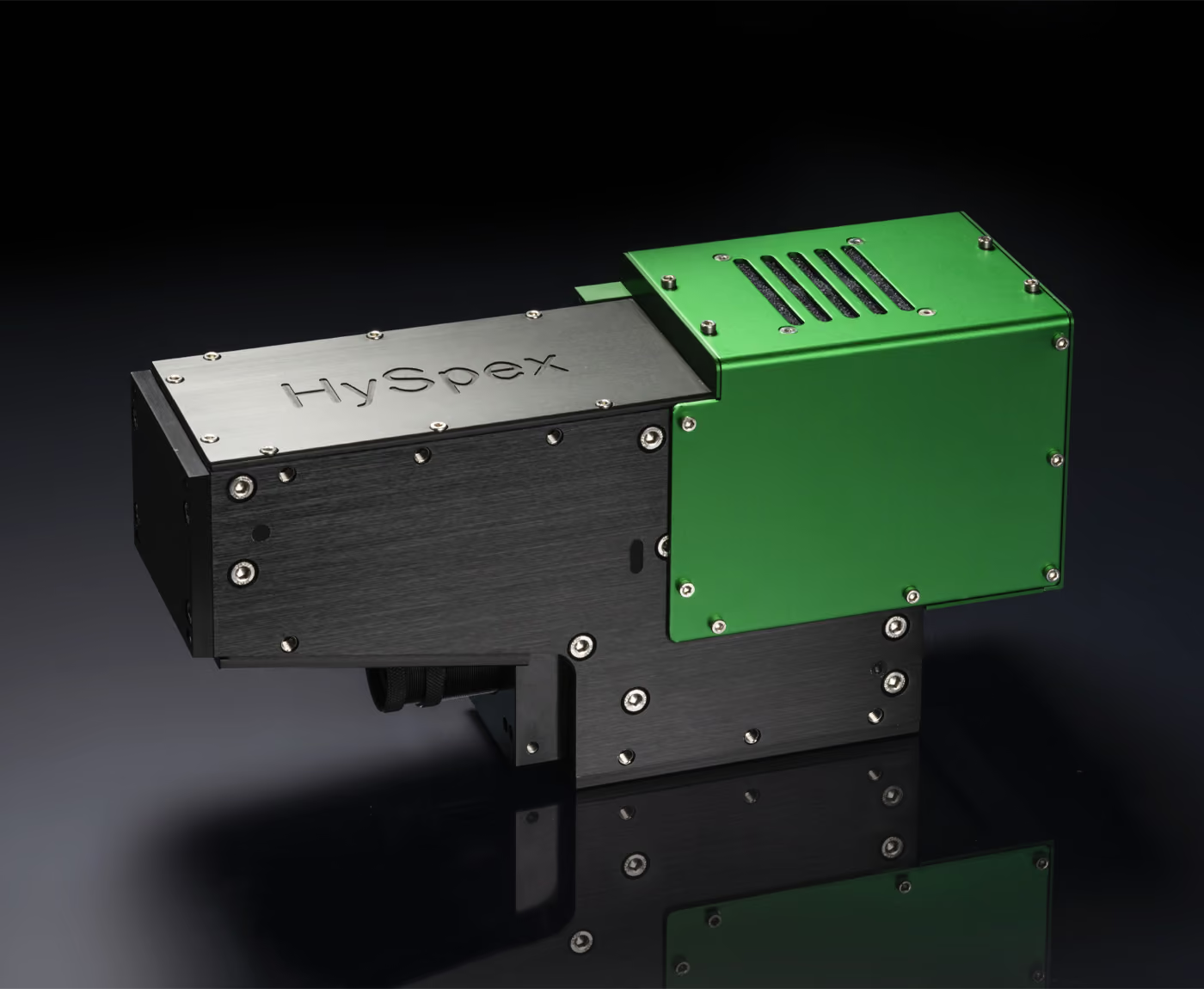

A hyperspectral camera is one of the most advanced optical sensing instruments available today. By combining imaging and spectroscopy into a single system, hyperspectral imaging enables precise material characterisation, quantitative analysis, and detailed scene understanding far beyond what conventional cameras or simple spectrometers can deliver.
Modern hyperspectral cameras are used in industrial automation, scientific research, environmental monitoring, defence, and space missions. At the forefront of this field, HySpex hyperspectral cameras represent a class of high-performance instruments designed for applications where data quality, stability, and measurement accuracy are critical.
At the core of these systems lies a powerful concept: every pixel in a hyperspectral image contains not only spatial information, but also a full spectrum. This transforms an image into a rich data source — known as hyperspectral imagery — where each point in the scene can be analysed based on its spectral signature.
What Is a Hyperspectral Imaging Camera?
A hyperspectral imaging camera, also referred to as an imaging spectrometer or spectral camera, captures both spatial and spectral information simultaneously.
Unlike a traditional camera that records intensity in three broad color channels (RGB), a spectrometer camera measures light in many narrow, contiguous wavelength bands. A single scene is therefore represented as a stack of images — one for each spectral band — forming a three-dimensional dataset often called a data cube (x, y, λ).
For every pixel, the system records a continuous spectrum of radiance or reflectance values. This allows users to:
- Identify materials based on their spectral fingerprints
- Detect subtle chemical or physical differences
- Classify objects with high accuracy
- Quantify properties that are invisible to the human eye
High-end systems such as our hyperspectral imaging cameras are engineered to preserve this spectral information with exceptional fidelity, enabling reliable quantitative analysis across demanding environments. In practical terms, a hyperspectral camera transforms an image into a spatially resolved measurement instrument.
From Light to Hyperspectral Imagery: The Operating Principle
Most high-performance hyperspectral imaging cameras, including our spectral cameras, operate using a pushbroom scanning principle.
Pushbroom Scanning
In a pushbroom system, the scene is recorded one narrow line at a time. The optical system images this line onto a slit. Light passing through the slit is then collimated and dispersed by a transmission grating or similar dispersive element. Different wavelengths are separated and projected onto a 2D detector array:
- One detector dimension represents spatial information along the line
- The other dimension represents spectral information
As the sensor or the scene moves — for example, through aircraft motion, satellite movement, or products passing on a conveyor belt — successive lines are captured. These lines are combined to form full hyperspectral imagery with two spatial dimensions and one spectral dimension.
As the sensor or the scene moves — for example, through aircraft motion, satellite movement, or products passing on a conveyor belt — successive lines are captured. These lines are combined to form full hyperspectral imagery with two spatial dimensions and one spectral dimension.
This architecture allows our spectral cameras to deliver high spectral resolution while maintaining excellent spatial detail.
Beyond Human Vision: Spectral Coverage from Visible to SWIR
A major advantage of advanced hyperspectral cameras is their ability to operate well outside the visible range. While human vision ends around 700 nm, HySpex hyperspectral imaging cameras can be configured to cover the visible, near-infrared (VNIR), and shortwave infrared (SWIR) ranges, extending up to approximately 2500 nm.
In these regions, materials exhibit characteristic absorption and reflection features linked to their molecular composition. This makes a spectrometer camera an essential tool for:
- Material identification and sorting
- Detection of moisture, contaminants, or defects
- Geological and environmental analysis
- Agricultural monitoring
- Scientific and laboratory measurements
Spectral information in the infrared often carries the key to distinguishing objects that appear identical in standard color imagery.
Imaging Spectrometers as Reliable Analytical Instruments
HySpex hyperspectral cameras, developed from decades of electro-optical research, are designed as stable and flexible systems that deliver consistent, high-quality data. Advances in detector technology, optical design, and computing power have transformed the hyperspectral imaging camera from a specialised research device into a robust analytical instrument.
Today’s hyperspectral cameras are deployed in:
- Online industrial monitoring and quality control
- Automated classification and sorting systems
- Laboratory and scientific instrumentation
- Medical and clinical research systems
- Airborne and satellite-based remote sensing
Because a hyperspectral imaging system represents a significant long-term investment and often supports years of scientific or industrial data collection, performance stability, calibration accuracy, and data quality are critical selection criteria — areas where HySpex imaging spectrometers are specifically engineered to perform.
Optical Sharpness, PSF, and Effective Information Content
When evaluating hyperspectral cameras or spectral cameras, headline specifications such as number of pixels, number of spectral bands, or frame rate only tell part of the story. A key performance factor is how well the optical system preserves information at the detector.
At HySpex we place strong emphasis on optical sharpness and sampling performance:
Sharp Optics per Pixel
For a given detector, sharper optics ensure that more independent information is captured. In an imaging spectrometer, optical sharpness directly affects how well fine spatial details and narrow spectral features are resolved. In a HySpex imaging spectrometer, both spatial and spectral sharpness are optimized to maximize effective information content.
Point Spread Function (PSF) and Sampling
The point spread function describes how a point in the scene is imaged onto the detector. The number of detector pixels sampling the PSF determines how accurately the signal is represented. Some HySpex hyperspectral cameras are designed according to Nyquist sampling principles, supporting repeatable spectral modeling and algorithm development, particularly in industrial environments. Systems designed according to these sampling principles aim to sample the PSF with at least two pixels, ensuring reliable spectral reproduction.
Understanding PSF relative to detector sampling helps determine the effective number of spatial pixels and spectral bands, which can differ significantly between two hyperspectral imaging cameras with similar datasheet values. Therefore, understanding these parameters helps users compare systems with similar specifications but very different real-world performance.
Hyperspectral Cameras for Airborne, Ground, and Industrial Use
HySpex hyperspectral cameras are deployed across a wide range of platforms and environments:
- Airborne systems, where low weight, low power consumption, and high frame rates are essential, and integration with IMU/GPS systems enables precise georeferencing of hyperspectral imagery
- Ground-based and laboratory setups, focused on stability, calibration and measurement accuracy.
- Industrial systems, where high-speed and repeatability are required, and the spectral cameras are integrated with production lines
- UAV and compact platforms, requiring compact imaging spectrometers with tight size and weight constraints and optimized performance
Depending on the application, trade-offs between sharpness, sampling strategy, speed, and data rate must be carefully balanced — a process supported by HySpex’s experience in both turnkey and custom solutions.
Hyperspectral Imaging Built on Electro-Optical Research Heritage
The performance of a hyperspectral camera is ultimately determined by the depth of expertise behind its optical, mechanical, and calibration design. Leading hyperspectral imaging cameras are not only products — they are the outcome of long-term electro-optical research and system engineering.
HySpex hyperspectral cameras originate from decades of imaging spectroscopy development within Norsk Elektro Optikk (NEO), Norway’s largest independent electro-optics research and development organization. Hyperspectral activities began as early as the mid-1990s through space-related instrumentation projects, forming a foundation in precision optics, sensor integration, and scientific measurement systems.
This R&D-driven background has shaped HySpex into an industry-recognized brand for both airborne and ground-based imaging spectrometers, known for:
- Stable and repeatable sensor performance
- Flexible system architectures
- High spectral and spatial data integrity
- Instrument designs intended for long-term scientific and industrial use
Such heritage is particularly important in applications where hyperspectral imagery must remain reliable over years of operation, across platforms, and between instruments — from industrial monitoring systems to research programs and remote sensing missions.
A Technology Built on Long-Term R&D
Our leading hyperspectral imaging cameras are the result of decades of electro-optical research and system development. Originating from advanced R&D in imaging spectroscopy and supported by high-level research and industrial projects, HySpex technology reflects a strong heritage in precision optics, calibration, and system engineering.
This foundation enables HySpex to deliver hyperspectral cameras that combine stability, flexibility, consistency and superior data quality — characteristics essential for fields such as for scientific research, defence, industrial monitoring, and remote sensing, where hyperspectral imagery must remain reliable and comparable across years of operation and across different instruments.
Hyperspectral Imaging as a Strategic Capability
A hyperspectral camera is more than a sensor — it is a measurement platform. By turning images into spectra-rich datasets, hyperspectral imaging cameras enable users to detect, classify, and quantify materials with a level of detail that was previously unattainable.
Whether deployed as a spectral camera in an industrial production line, as an imaging spectrometer in a research laboratory, or as a spectrometer camera aboard an aircraft or satellite, hyperspectral technology continues to expand the boundaries of what can be observed, analysed, and understood from optical data.
Explore Hyperspectral Imaging Solutions for Your Application
Selecting the right hyperspectral camera or imaging spectrometer requires careful consideration of spectral range, spatial performance, system stability, and integration with your specific platform or workflow.
HySpex works with research institutions, industrial partners, and system integrators to configure hyperspectral imaging cameras for airborne, ground-based, laboratory, and industrial environments.
If you are evaluating hyperspectral cameras for a specific application or platform, our team can provide technical guidance on system configuration, performance trade-offs, and integration options. Please contact us for more information.
Frequently Asked Questions About Hyperspectral Cameras
What is the difference between a hyperspectral camera and a multispectral camera?
A hyperspectral camera measures light in a large number of narrow, contiguous spectral bands, producing a near-continuous spectrum for each pixel. Multispectral cameras capture fewer, broader bands. This makes hyperspectral imaging better suited for detailed material identification, quantitative analysis, and detection of subtle spectral features.
How does a hyperspectral imaging camera work?
A hyperspectral imaging camera, often implemented as an imaging spectrometer, typically uses a pushbroom design. Light from a narrow line in the scene passes through a slit, is spectrally dispersed, and projected onto a detector. As the system or scene moves, successive lines are recorded to build a 3D dataset known as hyperspectral imagery.
What is hyperspectral imagery used for?
Hyperspectral imagery is used in industrial quality control, environmental monitoring, agriculture, geology, research, and remote sensing. Because each pixel contains a spectrum, materials can be identified, classified, and quantified based on their spectral properties.
What is an imaging spectrometer?
An imaging spectrometer is another term for a hyperspectral camera. It combines imaging optics with a spectrometer, allowing simultaneous acquisition of spatial and spectral data across a scene.
Why is spectral resolution important in hyperspectral cameras?
Higher spectral resolution allows finer discrimination between materials with similar spectral signatures. It improves classification accuracy and enables detection of subtle chemical or physical differences.