
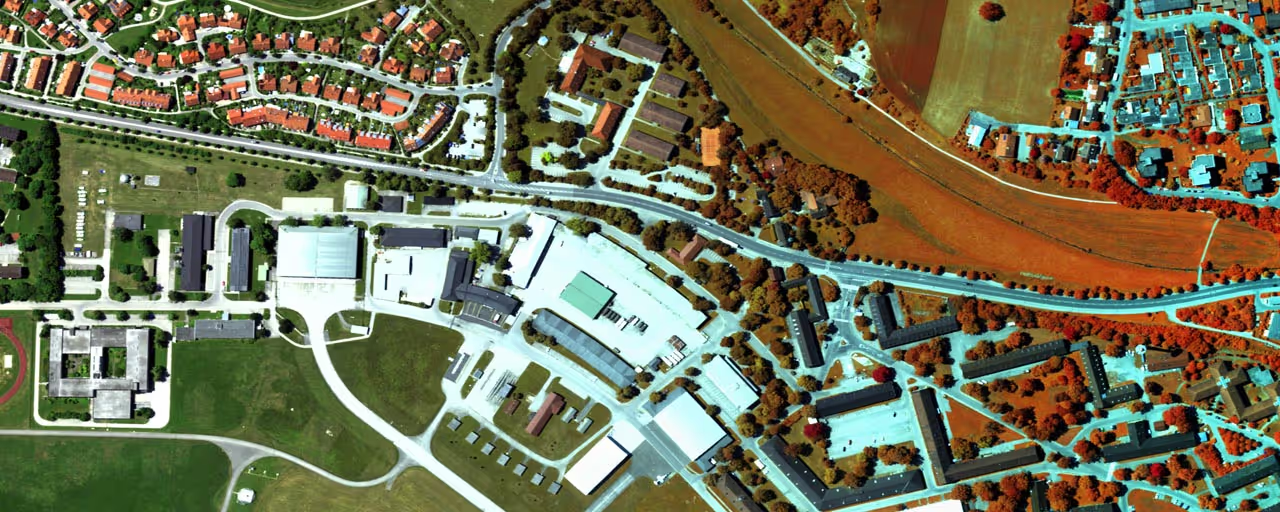

Hyperspectral imaging military applications have been an active research area for several decades, and the technology now plays a recognized role in defense, surveillance, and reconnaissance. By measuring how materials interact with light across many narrow spectral bands, hyperspectral systems can reveal information that conventional imaging cannot — including the presence of concealed materials, the composition of distant surfaces, and the chemical signatures of atmospheric or surface features.
This article looks at how hyperspectral imaging is used in defense and hyperspectral imaging surveillance contexts, what kinds of capabilities it enables, and what defines a system suitable for serious operational use.
Why Hyperspectral Imaging Matters in Defense
In a defense or surveillance context, the most valuable observation is often the one that is not visible to the eye. A target that has been deliberately camouflaged, a buried explosive, a chemical plume drifting downwind, or a material substituted to mislead an observer — each of these can defeat conventional optical imaging while leaving distinct spectral signatures that hyperspectral systems can detect.
This is the core reason hyperspectral imaging has been steadily integrated into defense research programs. Materials that look the same in RGB imagery can behave very differently across the visible, near-infrared, and shortwave infrared regions. Vegetation, fabric, plastic, painted surfaces, and engineered camouflage materials each have characteristic spectral responses, and those responses can be measured, compared, and classified.
The result is a sensor modality that adds an analytical dimension to traditional imaging. Instead of producing a visual record, a hyperspectral system produces a spectral measurement at every pixel — and that measurement can be linked to material identity, condition, or behavior in ways that visual interpretation cannot.
Core Military Applications of Hyperspectral Imaging
Defense research has identified several application areas where hyperspectral imaging contributes meaningful capability beyond what conventional optical or infrared imaging can provide.
Camouflage, Concealment, and Deception Detection
Camouflage, concealment, and deception (CCD) materials are designed to defeat human vision and standard optical systems. Many of them succeed in the visible spectrum but reveal themselves in the near-infrared or shortwave infrared, where natural vegetation, soil, and engineered materials diverge spectrally. Hyperspectral systems can identify these differences and flag suspect areas for closer investigation. The same capability supports the analysis of how friendly camouflage materials perform against hyperspectral threats — increasingly important as adversary sensor capabilities mature.
Target Detection and Material Discrimination
In open environments, hyperspectral data can support automatic detection of materials with known spectral signatures — for example, distinguishing a vehicle painted in standard automotive paint from one painted in military-spec coatings, or identifying specific construction materials in a complex scene. The underlying principle of identifying materials by their spectral fingerprints is the same one that drives hyperspectral imaging in mining, where the targets are minerals rather than military objects. The technique is particularly valuable in defense contexts when targets are partially obscured or when conventional imaging cannot resolve them clearly.
Intelligence, Surveillance, and Reconnaissance
Hyperspectral payloads on airborne, UAV, and satellite platforms contribute to broader intelligence, surveillance, and reconnaissance (ISR) operations. Wide-area spectral mapping can identify changes over time, support pattern-of-life analysis, and provide material context that complements other ISR sensors. Hyperspectral imaging surveillance in this sense is rarely a stand-alone capability; it is part of a layered sensor architecture in which spectral data adds analytical depth to imagery, radar, and signals intelligence.
Mine and Improvised Explosive Device Detection
Buried or surface-laid explosives often leave subtle disturbances in soil, vegetation, and surface materials that hyperspectral systems can detect. Disturbed soil has different spectral characteristics than undisturbed surroundings, recently buried devices may affect vegetation health in detectable ways, and certain explosive precursor materials have identifiable absorption features. While operational detection remains challenging and is typically combined with other sensing modalities, hyperspectral imaging has been an active area of research in this domain for many years.
Chemical and Plume Detection
Atmospheric gases and chemical plumes have characteristic absorption features in the infrared. Hyperspectral systems with appropriate spectral coverage can detect, identify, and even quantify these features — supporting applications from chemical agent detection on the battlefield to monitoring of industrial emissions in the broader security context.
Surveillance Applications Beyond Traditional Defense
The same spectral capabilities that support military operations also extend into civilian and dual-use security applications. Border monitoring benefits from the ability to detect materials and activities that conventional cameras miss. Critical infrastructure protection — including airports, ports, and energy facilities — uses hyperspectral sensing for both perimeter monitoring and post-incident analysis. Maritime surveillance applications include oil spill detection, vessel identification by material composition, and monitoring of port environments. Counter-narcotics and counter-trafficking operations can use hyperspectral mapping to identify cultivation, processing, or material movement that visual imagery would not reveal.
These civilian and dual-use applications often drive much of the operational deployment of hyperspectral imaging, because they combine real-world demand with budgets and timelines that move faster than traditional defense procurement.
Platform Considerations for Defense and Surveillance Systems
Defense and surveillance applications place demanding requirements on the platforms that carry hyperspectral payloads. Airborne manned aircraft remain important for wide-area mapping and persistent ISR coverage, and the underlying principles of airborne hyperspectral data acquisition are discussed in more depth in our overview of hyperspectral remote sensing systems. UAVs of various sizes have expanded the range of feasible deployments, enabling lower-cost, lower-risk, and more flexible operations — particularly with the development of compact hyperspectral payloads that combine scientific-grade data quality with the size, weight, and power constraints of drone platforms. Satellite-based hyperspectral systems are increasingly capable and increasingly available, supporting strategic monitoring at scales no airborne system can match.
Each platform comes with its own trade-offs in spatial resolution, revisit frequency, area coverage, and survivability. The right configuration depends on the mission, and serious defense programs typically integrate hyperspectral data from multiple platforms into a unified analytical picture.
HySpex Heritage in Defense and Space Technology
The roots of HySpex run deep in defense and aerospace research. Norsk Elektro Optikk (NEO), the parent company behind the HySpex brand, was founded in 1985 by researchers from the Norwegian Defence Research Establishment (FFI), bringing decades of electro-optical research and development expertise into the commercial sector. That defense and research heritage has continued to shape the company's product development philosophy: data quality, calibration stability, optical precision, and long-term system reliability — all characteristics that matter as much in defense and aerospace as they do in scientific research.
HySpex has also been an active participant in space programs since the mid-1990s, beginning with the HISS project for the European Space Agency in 1995. More recently, HySpex was selected as the supplier of a hyperspectral camera for a commercial in-orbit servicing mission, delivering a NIR imaging system covering the 950–1700 nm range with 640 spatial pixels and 360 spectral channels. While that particular contract is commercial space rather than defense, the engineering disciplines required — space-qualified optics, ruggedization, calibration stability, integration with constrained platforms — are directly transferable to defense applications.
The company's hyperspectral product families also include configurations developed specifically for defense and ISR applications. The HySpex Mjolnir OEM systems are purpose-built for integration into intelligence, surveillance, and reconnaissance platforms, combining scientific-grade hyperspectral data quality with the compact form factor, low weight (~2 kg), and low power consumption required by UAVs and other ISR assets. The OEM solution is delivered as an integration-ready payload that includes the hyperspectral camera, an onboard processing computer, and a navigation system with optional GNSS-denied capability — a specifically defense-relevant feature for operations in contested electromagnetic environments. The systems are compatible with HySpex Bifrost real-time software, enabling onboard processing and analytics for defense and intelligence missions where actionable insight is needed during acquisition rather than after.
Beyond the dedicated OEM defense product, the broader HySpex Mjolnir series provides compact, scientific-grade hyperspectral cameras for UAV and field deployment as a generic payload that can be integrated onto any UAV with sufficient lift capacity. The Mjolnir series itself has defense roots — it was originally developed out of a joint Norwegian/French defense contract for a compact hyperspectral camera designed specifically for UAV use, reflecting the engineering priorities of military deployment from its inception. The dedicated HySpex UAV turnkey solution bundles a Mjolnir camera with onboard computing and an Applanix navigation system in a single self-contained module, simplifying integration with high-performance unmanned platforms. An IP65-rated version of the Mjolnir VS-620 is additionally available for unattended operation in exposed environmental monitoring scenarios. Together, these product configurations reflect both the dedicated defense engineering invested in the Mjolnir OEM line and the broader capability HySpex brings to operational hyperspectral imaging.
The European Defence Agency Hyper-IP Project
A direct example of HySpex's role in defense research is the European Defence Agency Hyper-IP project, officially launched in January 2025. The project addresses technological gaps in defense-related hyperspectral imaging by designing and developing a hyperspectral camera paired with innovative signal processing, intended for satellite deployment and demonstrated on an airborne platform during the project.
The Hyper-IP consortium brings together leading European research and industry organizations. Flysight Srl leads the project, with participation from the Royal Military Academy specializing in hyperspectral data analysis for defense, the National Institute of Optics of the National Research Council (INO) contributing optical research expertise, IMEC providing advanced imaging sensor technology, Leonardo S.p.A delivering aerospace and defense solutions, and NEO responsible for designing and constructing the hyperspectral camera.
In the project context, NEO has highlighted that participating in collaborative research of this kind is essential for continuing to develop high-end hyperspectral products and exploring new techniques alongside established pushbroom architectures. The Hyper-IP camera design phase began in Q2 2025, with completion expected in Q2 2026 — a timeline that reflects the engineering complexity of building hyperspectral systems intended for satellite deployment in defense contexts.
What Defines a Defense-Grade Hyperspectral System
Not all hyperspectral systems are suitable for defense use. Several characteristics consistently separate systems that perform in operational conditions from those that work only in benign laboratory environments.
Calibration stability over time and temperature is essential. Defense systems often operate under conditions that stress optical and electronic components, and a system whose calibration drifts under those conditions produces unreliable data exactly when reliable data matters most.
Low optical distortions — including smile, keystone, and stray light — directly affect the system's ability to detect subtle spectral features. For target detection or chemical signature identification, even small distortions can degrade detection probability or increase false alarms.
Spectral fidelity and signal-to-noise ratio determine whether the system can distinguish the spectral features that matter for the application. A defense-grade system needs to deliver useful data across its full spectral range, not just nominally cover the wavelengths in question. The underlying acquisition architecture matters here as well — most scientific-grade defense and ISR systems use pushbroom rather than snapshot hyperspectral cameras precisely because the calibration stability and spectral fidelity required for operational use are easier to achieve with scanning architectures.
Robustness and integration matter at the platform level. The system must survive transportation, mounting, environmental exposure, and the constraints of the host platform — and integrate cleanly with navigation systems, data links, and downstream processing chains.
Long-term supportability is often underappreciated. Defense systems are typically expected to remain operational for many years, which places demands on the manufacturer's ability to maintain calibration services, provide spare parts, and support evolving requirements over the system's lifecycle.
Looking Ahead — Hyperspectral Imaging in Modern Defense
Hyperspectral imaging is no longer an emerging defense technology. It is a maturing capability with established research foundations, growing operational deployment, and increasing integration into multi-sensor ISR and surveillance architectures. As platforms become more capable, as data processing pipelines mature, and as machine learning improves the speed and reliability of spectral classification, the operational value of hyperspectral imaging military applications continues to grow.
For defense organizations, system integrators, and research partners evaluating hyperspectral imaging for operational or research use, the most important factors remain consistent: data quality, calibration stability, platform fit, and the engineering discipline of the supplier behind the system.
Discuss Hyperspectral Imaging for Defense and Security Applications
Selecting a hyperspectral imaging system for defense, surveillance, or security applications involves more than reviewing top-level specifications. Calibration strategy, optical performance under operational conditions, platform integration, and long-term support all shape whether a system will deliver useful data when it matters.
HySpex develops scientific-grade hyperspectral imaging systems with a heritage in defense and aerospace research, and participates in European defense research programs such as the EDA Hyper-IP project. If your work involves defense, surveillance, security, or related research requirements, a technical discussion about your specific application is often the best starting point. Feel free to contact us for more information.
FAQ – Hyperspectral Imaging in Military Applications and Surveillance
How is hyperspectral imaging used in military applications?
Hyperspectral imaging military applications include camouflage, concealment, and deception detection, target identification and material discrimination, intelligence and reconnaissance support, mine and improvised explosive device detection, and chemical and plume detection. Defense organizations use hyperspectral data to extract material and chemical information from scenes that conventional imaging cannot reveal.
Can hyperspectral imaging detect camouflage?
Yes. Many camouflage materials are designed to defeat the human eye and standard optical systems but reveal themselves in the near-infrared or shortwave infrared, where their spectral behavior differs from natural surroundings. Hyperspectral systems can detect these differences and flag suspect areas for closer analysis. The same capability is used to evaluate the performance of friendly camouflage against hyperspectral threats.
What is the difference between multispectral and hyperspectral imaging in defense?
Multispectral systems measure a small number of selected wavelength bands and are well established in defense remote sensing. Hyperspectral systems measure many narrow contiguous bands, providing much richer spectral detail and supporting applications that require detection of subtle material or chemical features. The choice between the two depends on the mission, the spectral features of interest, and the platform constraints.
What is ISR in the context of hyperspectral imaging?
ISR stands for intelligence, surveillance, and reconnaissance — a broad set of military activities focused on collecting and analyzing information about an operational environment. Hyperspectral imaging contributes to ISR by adding material and chemical information to imagery from airborne, UAV, and satellite platforms, typically as part of a layered sensor architecture rather than as a standalone capability.
Can hyperspectral cameras be deployed on satellites?
Yes. Satellite-based hyperspectral systems are an active and growing area of defense and dual-use space technology. Programs such as the European Defence Agency Hyper-IP project are specifically focused on developing hyperspectral cameras suitable for satellite deployment, and the engineering disciplines involved — space qualification, calibration stability, integration with constrained platforms — overlap closely with those required for commercial space hyperspectral systems.