

Hyperspectral remote sensing combines high-resolution spectral measurement with large-area observation. By capturing detailed spectral information across wide scenes, hyperspectral remote sensing systems enable material identification, environmental monitoring, and surface analysis at a level of detail beyond conventional imaging.
These systems are used in airborne, UAV, and satellite-based platforms where both spatial coverage and spectral precision are essential.
What Is Hyperspectral Remote Sensing?
Hyperspectral remote sensing is the application of hyperspectral imaging technology in remote observation scenarios. Instead of measuring a small object in a laboratory, sensors observe landscapes, vegetation, geological formations, or built environments from a distance.
A hyperspectral remote sensing system captures a continuous spectrum for each pixel in the scene. This spectral information allows surfaces to be characterized based on their optical properties, enabling analysis of materials rather than just shapes or colors.
How Hyperspectral Remote Sensing Systems Work
Most hyperspectral remote sensing systems are based on imaging spectrometer technology and operate using pushbroom scanning.
A narrow line in the scene is imaged through a slit, and the light is spectrally dispersed before reaching the detector. One dimension of the detector records spatial information along the line, while the other records spectral information. As the aircraft, UAV, or satellite moves, successive lines are recorded and assembled into a hyperspectral dataset.
To ensure accurate mapping, airborne systems are typically integrated with:
- Inertial measurement units (IMU)
- GPS systems
- Dedicated data acquisition and control software
This integration enables precise georeferencing of hyperspectral data.
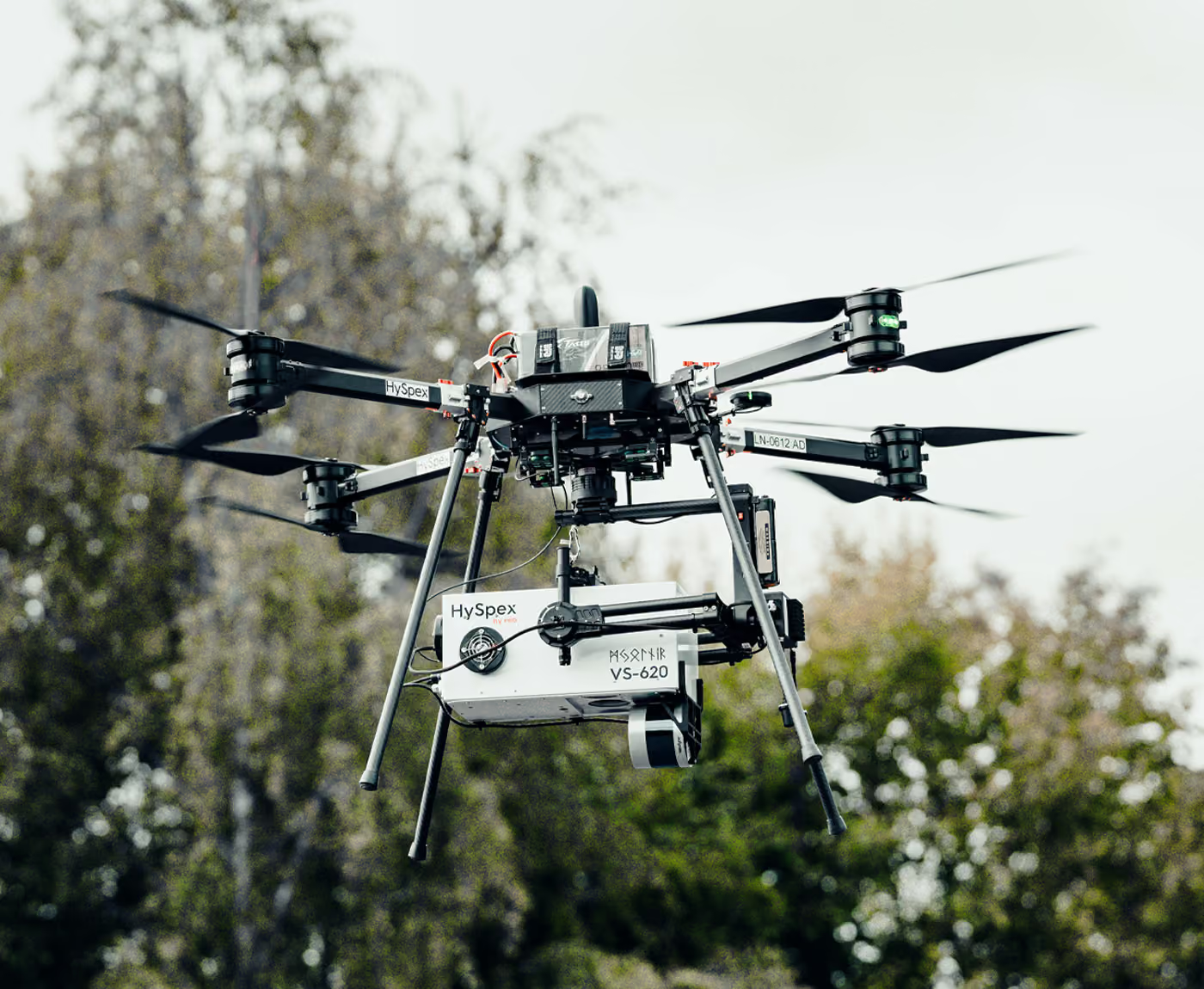
Compact UAV-adapted hyperspectral systems further extend remote sensing capabilities to lightweight drone platforms. Systems such as the HySpex Mjolnir series are designed with low mass and small form factor while maintaining scientific-grade spectral performance. Integrated bundles combining the sensor, onboard computing, and navigation systems allow hyperspectral remote sensing to be deployed on high-performance UAVs, enabling flexible data acquisition over agricultural, environmental, and research sites.
Spectral Range in Remote Sensing Applications
A key advantage of hyperspectral remote sensing is the ability to operate beyond the visible spectrum. Systems may cover visible, near-infrared (VNIR), and shortwave infrared (SWIR) regions.
In these wavelength ranges, materials exhibit distinct absorption and reflection features linked to chemical composition and physical structure. This makes hyperspectral remote sensing particularly powerful for analyzing vegetation, minerals, soils, and environmental conditions.
Applications of Hyperspectral Remote Sensing
Hyperspectral remote sensing applications span scientific, environmental, and industrial domains:
Environmental and Ecosystem Monitoring
Spectral data supports assessment of vegetation health, species differentiation, and ecosystem changes.
Geological and Mineral Mapping
Minerals exhibit characteristic spectral signatures, enabling identification and mapping of geological formations.
Surface and Terrain Analysis
Hyperspectral remote sensing systems provide detailed information about surface materials and conditions across large areas.
Research and Scientific Studies
Researchers use airborne and satellite hyperspectral data to develop models, validate measurements, and study complex natural processes.
System Requirements for Remote Sensing
A hyperspectral remote sensing system must meet strict performance criteria:
- High spectral fidelity and stability
- Accurate calibration
- Low weight and power consumption for airborne platforms
- Robust optical and mechanical design
Because these systems often support long-term monitoring or scientific programs, data consistency over time is essential.
HySpex hyperspectral imaging systems are designed for demanding environments, supporting airborne, UAV, and field-based deployments where precision and reliability are critical.
Hyperspectral Remote Sensing as a Measurement Technology
Unlike conventional aerial imaging, hyperspectral remote sensing treats the scene as a measurable surface. Each pixel becomes a spectral measurement point, enabling quantitative analysis of material properties.
This capability transforms remote sensing from visual mapping to analytical observation, supporting decision-making in environmental science, geology, and advanced research.
Develop Your Hyperspectral Remote Sensing Capability
Designing an effective hyperspectral remote sensing system requires careful consideration of spectral performance, system stability, platform integration, and data processing workflows.
HySpex develops advanced hyperspectral imaging systems used in airborne, UAV, and field-based remote sensing applications. Our solutions are designed for researchers, environmental specialists, and technical users who rely on accurate and stable spectral measurements in demanding environments.
If your project involves large-area spectral mapping, environmental analysis, or research-driven remote sensing, we can provide guidance on system configuration, optical performance, and integration with your platform. Feel free to contact us for more information.
FAQ – Hyperspectral Remote Sensing
What is hyperspectral remote sensing?
Hyperspectral remote sensing is the use of hyperspectral imaging technology to observe and analyze surfaces from a distance, typically using airborne, UAV, or satellite platforms. It provides both spatial and spectral information for material characterization.
What is a hyperspectral remote sensing system?
A hyperspectral remote sensing system typically includes an imaging spectrometer, optics, calibration components, data acquisition hardware, and navigation systems such as IMU and GPS for georeferencing.
How is hyperspectral remote sensing different from traditional remote sensing?
Traditional remote sensing often relies on broad spectral bands or visual imagery. Hyperspectral remote sensing measures many narrow spectral bands, enabling more detailed material identification and quantitative analysis.
What are hyperspectral remote sensing systems used for?
They are used in environmental monitoring, vegetation studies, geological mapping, surface analysis, and scientific research where detailed spectral information is required.
Why is spectral range important in remote sensing?
Different materials have characteristic spectral features in visible, near-infrared, and shortwave infrared wavelengths. A wide spectral range allows better discrimination and analysis of surface materials.