
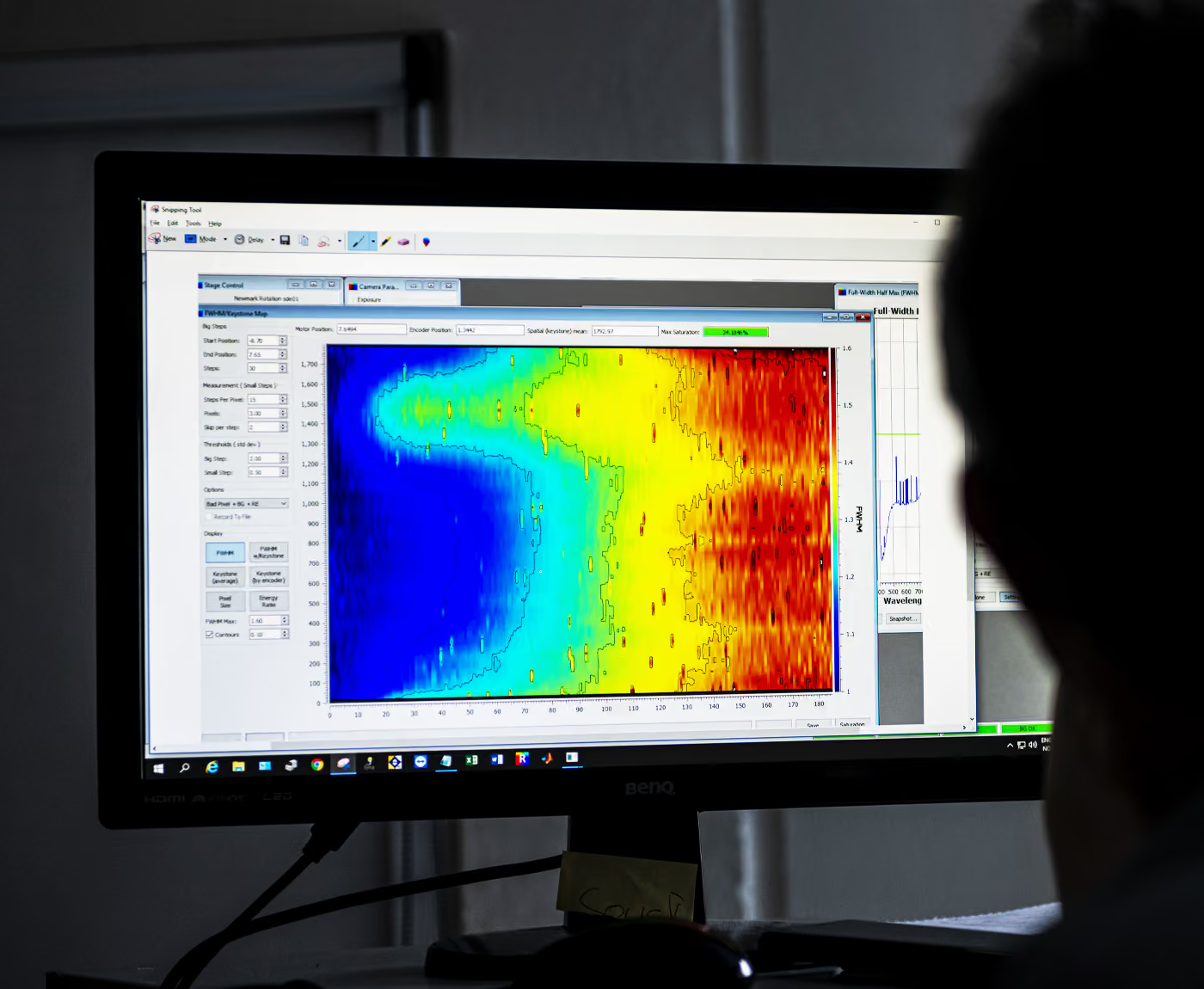

Hyperspectral software plays a critical role in transforming raw spectral data into actionable information. While hyperspectral imaging systems capture detailed spectral measurements, it is advanced software that enables interpretation, modelling, classification, and real-time decision-making.
From laboratory research to industrial production lines, hyperspectral software bridges the gap between sensor data and practical application.
The Role of Software in Hyperspectral Imaging
Hyperspectral imaging systems generate large volumes of complex data. Each hyperspectral image contains spectral information for every pixel, often across hundreds of wavelength bands. Managing, analysing, and applying this data requires specialised tools.
Hyperspectral software typically supports:
- Data acquisition and system control
- Spectral preprocessing and calibration handling
- Visualisation of hyperspectral datasets
- Development of classification and regression models
- Real-time analysis and industrial integration
Without dedicated software, the full analytical potential of hyperspectral imaging cannot be realized.
From Data to Insight: Core Functions of Hyperspectral Software
Modern hyperspectral software platforms are designed to support the complete workflow from raw data to operational results.
Data Analysis and Visualisation
Software tools allow users to explore hyperspectral images, inspect spectra, and compare spectral signatures across regions of interest. Visualisation is essential for understanding patterns and identifying relevant spectral features.
Application Modelling
For many hyperspectral imaging applications, users develop models that link spectral information to physical or chemical properties. Hyperspectral software provides tools for building, testing, and validating such models.
Classification and Quantification
Advanced algorithms enable automatic material classification, object identification, and chemical quantification. These capabilities are particularly important in industrial process monitoring and quality control.
Hyperspectral Software for Research and Development
In research environments, hyperspectral software supports exploration, method development, and model building.
Researchers use these platforms to:
- Develop new analytical approaches
- Build spectral libraries
- Test processing workflows
- Evaluate system performance
User-friendly interfaces combined with advanced analytical tools make hyperspectral software suitable both for experts and for users entering the field.
Real-Time Hyperspectral Software for Industrial Systems
Industrial applications require hyperspectral software that can operate in real time. Here, the focus shifts from exploratory analysis to automated decision-making.
Real-time hyperspectral software can:
- Process data streams from sensors on production lines
- Classify materials on the fly
- Quantify chemical or physical properties
- Integrate results into existing control systems
This enables hyperspectral imaging to function as an operational tool rather than an offline analytical method.
Specialised Hyperspectral Software for Geology and Materials
In geological and mineral applications, hyperspectral software supports interpretation of spectral features linked to mineral composition.
Dedicated tools may include:
- Built-in spectral libraries
- Mineral identification algorithms
- Tools for logging and exporting interpretations
These features streamline workflows from field data collection to analysis and reporting.
An Integrated Hyperspectral Software Ecosystem
Modern hyperspectral imaging solutions often combine sensors and software into a unified ecosystem. Within the HySpex environment, dedicated software platforms developed in collaboration with Prediktera support:
- Research and application development
- Routine analysis
- Industrial integration
- Geological interpretation
This integration allows users to move from data acquisition to real-time application within a consistent workflow.
Hyperspectral Software as an Enabler of Applications
Across all hyperspectral imaging applications, software determines how effectively spectral data can be used. From laboratory studies to industrial systems, hyperspectral software enables:
- Faster development of applications
- More reliable analysis
- Seamless integration with operational environments
As hyperspectral technology continues to evolve, software remains a central component in turning spectral measurements into practical insight.
Develop and Deploy Your Hyperspectral Application
Turning spectral data into reliable results requires the right combination of sensors, algorithms, and software tools. Whether your focus is research, application development, or industrial integration, hyperspectral software plays a central role in enabling accurate analysis and operational workflows.
HySpex works together with specialised software platforms to support the full hyperspectral workflow — from data acquisition and model development to real-time analysis and system integration.
If your project involves spectral classification, chemical quantification, or real-time material analysis, we can provide guidance on hyperspectral software capabilities and system integration strategies. Feel free to contact us for more information.
FAQ – Hyperspectral Software
What is hyperspectral software?
Hyperspectral software refers to specialised tools used to acquire, process, visualise, and analyse hyperspectral imaging data. It enables users to interpret spectral information and build models for classification, quantification, and material identification.
Why is hyperspectral software necessary?
Hyperspectral systems produce complex datasets with hundreds of spectral bands per pixel. Software is required to handle data processing, visualisation, model development, and integration into research or industrial workflows.
Can hyperspectral software be used in real-time applications?
Yes. Many hyperspectral software solutions support real-time processing, allowing spectral data to be analysed directly on production lines or in operational systems for automated decision-making.
Is hyperspectral software only for researchers?
No. While hyperspectral software is widely used in research, it is also essential in industrial environments, geological applications, and routine analysis where automated workflows and integration are required.
Does hyperspectral software include spectral libraries?
Some hyperspectral software platforms include built-in spectral libraries or allow users to create custom libraries. These are used to compare measured spectra with known material signatures.