
Hyperspectral Imaging for Textile Sorting
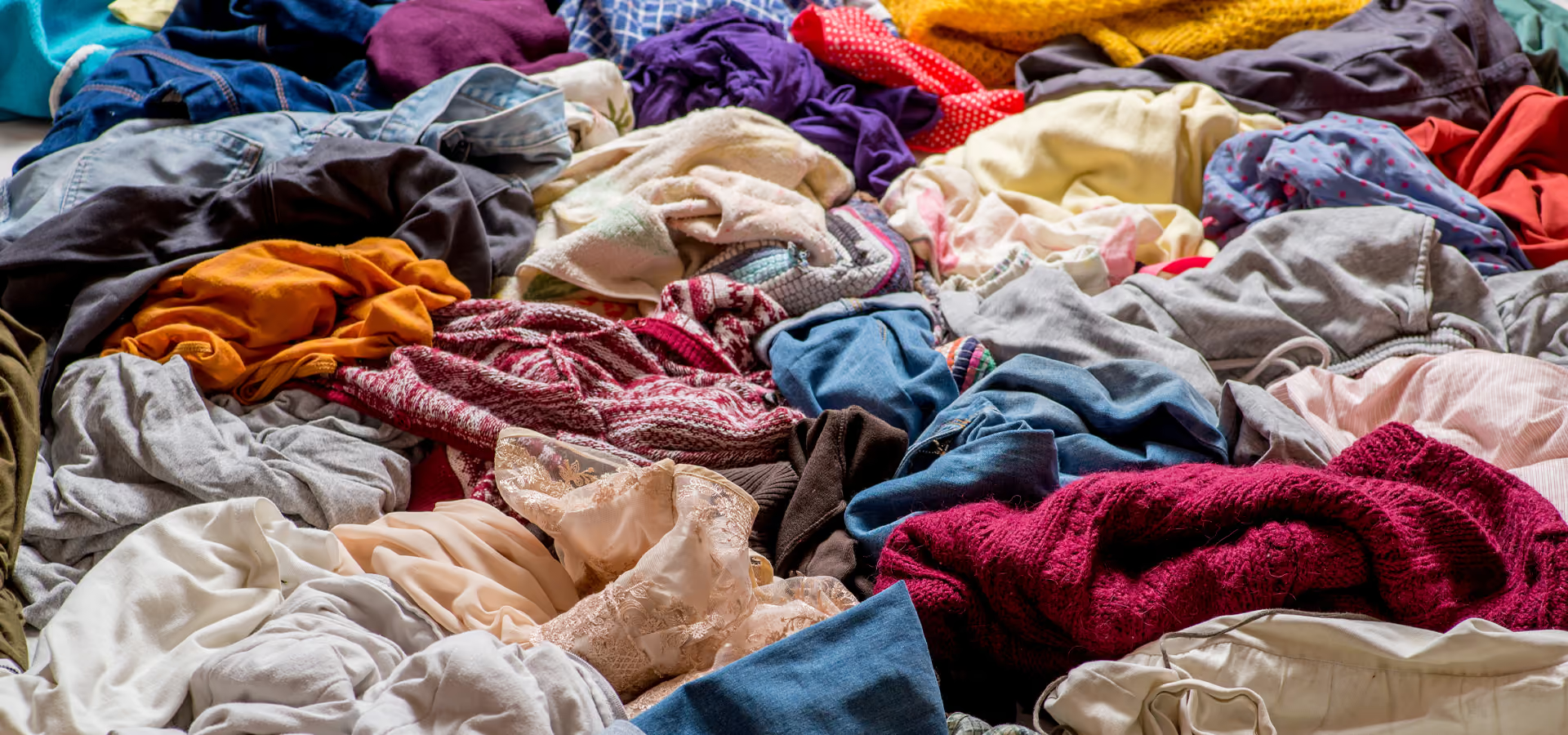

Hyperspectral imaging has a lot to offer within the increasingly prominent and important world of textile sorting — a sector under rapid expansion since EU regulations on separate textile collection took effect in 2025.
Textile sorting plays a crucial role in addressing environmental issues by facilitating the recycling and reuse of materials, which helps reduce waste and conserve resources. As the clothes manufacturing industry is a significant contributor to global pollution, efficient textile sorting systems can significantly mitigate this impact. By separating textiles based on their material composition, color, and condition, sorted items can either be repurposed, upcycled, or recycled into new products, thus reducing the need for new materials and minimising the overall environmental footprint.
An Automated Textile Sorting Machine
Sorting textiles by fibre type at industrial volumes is not something that can be done by hand. It requires a machine that identifies each item as it passes, decides what it is, and physically separates it — all within the fraction of a second between imaging and the ejection point.
Norsk Tekstilgjenvinning (NTG) operates Norway's first textile-to-textile recycling facility, in Sandefjord. To handle the sorting step, the company established Norsk Tekstilsortering (NTS) as a subsidiary, deliberately co-located with the recycling plant so that collection, sorting, and recycling could be developed as one process rather than three separate ones. The reasoning is straightforward: textiles have to be sorted correctly for recycled fibre to reach the quality that new textile production requires.
The fully automated textile sorting machine built for that operation is a Norwegian collaboration. HySpex, through parent company Norsk Elektro Optikk (NEO), supplied a complete hardware and software solution for real-time textile classification — including the interface to the machine's PLC that controls the valves performing the physical separation. The sorter allows for automatic classification and sorting of textiles, and can sort 4 to over 100 types/mixtures of fibres.
The use of hyperspectral imagers significantly enhances the efficiency and accuracy of textile sorting by enabling the precise identification of different fibres and materials. By analysing the unique spectral signatures of various fabrics, hyperspectral imagers can quickly and accurately sort textiles into specific categories, such as cotton, polyester, or wool, which is essential for effective recycling. This technology not only speeds up the sorting process, but also leads to higher recycling rates and a more sustainable management of textile waste.
The Benefits of eSWIR over SWIR Hyperspectral Imaging
Collected textile waste contains a wide variety of fibre types, blends, colours, impurities, and material qualities. Efficient recycling depends on the ability to separate these materials into high-purity fractions that can be directed towards the most appropriate recycling pathways.
Short wavelength infrared (SWIR) hyperspectral imaging has proven to be a powerful enabler for real-time automated sorting of textile waste. However, the value potential of a solution is limited by the wavelength range of the hyperspectral device. Many solutions on the market use a rather narrow SWIR range of 950-1700 nm or similar.
While such sensors may work well for simple or well-controlled sorting problems, they often fall short in detecting many different fibre types or blends from complex input streams simultaneously.
Extended SWIR (eSWIR) hyperspectral imaging covering 950–2500 nm provides access to significantly richer chemical information, including the near-infrared (NIR) combination band region. This additional information can improve fibre identification, blend quantification, sorting sensitivity, and sorting purity across complex textile waste streams.
Some benefits of eSWIR hyperspectral imaging include:
♦️ Improved identification and quantification of elastane-containing blends
♦️ Significant potential economic gains through improved recovery rates and sorting purity
♦️ Improved characterization of multiple fibres and blends of similar chemistry, such as different animal-based or synthetic fibre mixtures
♦️ Better differentation of cellulose-based fibres, such as cotton and viscose
Benefits of Extended SWIR (eSWIR) Hyperspectral Imaging for Textile Sorting
Short wavelength infrared (SWIR) hyperspectral imaging has proven to be a powerful enabler for real-time automated sorting of textile waste. However, the value potential of a solution is limited by the wavelength range of the hyperspectral device. Many solutions on the market use a rather narrow SWIR range of 950-1700 nm or similar. While such sensors may work well for simple or well-controlled sorting problems, they often fall short in detecting many different fibre types or blends from complex input streams simultaneously.
Extended SWIR (eSWIR) hyperspectral imaging covering 950–2500 nm provides access to significantly richer chemical information, including the near-infrared (NIR) combination band region. This additional information can improve fibre identification, blend quantification, sorting sensitivity, and sorting purity across complex textile waste streams.
Some key benefits of using eSWIR hyperspectral imaging for textile waste sorting include:
♦️ Improved identification and quantification of elastane-containing blends using eSWIR compared with a reduced SWIR range.
♦️ Significant potential economic gains through improved recovery rates and sorting purity.
♦️ Improved characterization of multiple fibres and blends of similar chemistry, such as different animal-based or synthetic fibre mixtures.
♦️ Improved differentiation of cellulose-based fibres such as cotton and viscose.
.webp)
Technical White Paper:
Sorting High-Volume Complex Textile Blends for Recycling
Interested in learning more about how eSWIR hyperspectral imaging can be used to improve textile sorting solutions?
The paper draws on industrial development work carried out by Norsk Elektro Optikk AS (NEO) and Norsk Tekstilgjenvinning, (NTG), combining proven hyperspectral imaging expertise with large-scale textile recycling experience. It highlights limitations of some conventional SWIR approaches, the advantages of eSWIR hyperspectral imaging, and the economic impact of improved sorting performance.
Access the whole white paper for free by following the link below.
Want to learn even more about Advanced Textile Sorting?
Want to learn even more about how hyperspectral imaging can take textile sorting to the next level?
In the webinar, experts from HySpex and Prediktera show real-world examples and use cases, discuss current industry challenges, host a live Q&A session and more!
Access the free 50-minute webinar on demand by following the link below.

The Demand for Improved Waste Sorting in EU States
Since 1 January 2025, every EU Member State has been required to collect textiles separately from mixed household waste.¹ Before that deadline, only around half of Member States had separate textile collection in place, and most of those systems were built to capture reusable garments rather than material for recycling.
On 16 October 2025, the revised Waste Framework Directive — Directive (EU) 2025/1892 — entered into force, introducing common EU rules for extended producer responsibility.² Producers of textiles and footwear now pay a fee for each product placed on the market, financing collection and the management of what is collected: reuse, preparation for reuse, recycling, and disposal. Fees are eco-modulated according to sustainability criteria including durability and recyclability. Member States have 20 months to transpose the Directive and 30 months to establish producer responsibility schemes.
Sorting is now a legal precondition for shipment. Under the revised Directive, all separately collected textiles are classified as waste, and Member States must ensure that separately collected textiles undergo sorting operations before any possible shipment. The purpose is explicit: to prevent waste being mislabelled and exported as reusable material. Unsorted textile waste falls under the Waste Shipment Regulation.
For sorting operators, this is the provision that matters most. Exporting an unsorted collection stream as reusable goods is no longer an available route, which makes domestic sorting capacity the constraint that determines whether collected material can move at all.
EU Member States generated around 6.94 million tonnes of textile waste in 2022 — roughly 16 kg per person, a figure that has been broadly stable since 2016.³ The capture rate for household textile waste reached just under 15% that year, having risen 4.3 percentage points since 2016. Counting separate collection from households and economic activities together, 4.6 kg per person was collected separately against 11.1 kg per person that was not.
Our article on textile recycling covers the regulatory framework and the value chain in more detail.
NEO as an Original Equipment Manufacturer
NEO, through the brand HySpex, is recognized as a leading original equipment manufacturer (OEM) of hyperspectral systems for many key service providers in various industries. Hyperspectral sorting has moved from pilot projects into commercial operation across several industries, from textile and plastic recovery to food grading and hazardous waste separation. NEO provides camera modules or fully-integrated hyperspectral solutions that come with real-time processing software. For those who prefer to manage the software independently, a platform-independent Software Development Kit (SDK) is provided to support development needs.
NEO is continuing to innovate, collaborate and offer new solutions within the fields of hyperspectral imaging. If you're looking to increase efficiency and lower costs for your operation, please contact us for more information.
Sources:
1. European Environment Agency: Management of used and waste textiles in Europe's circular economy
2. European Commission: Revised Waste Framework Directive enters into force (16 October 2025)
3. European Environment Agency: Textile waste generation per person in the EU per year