
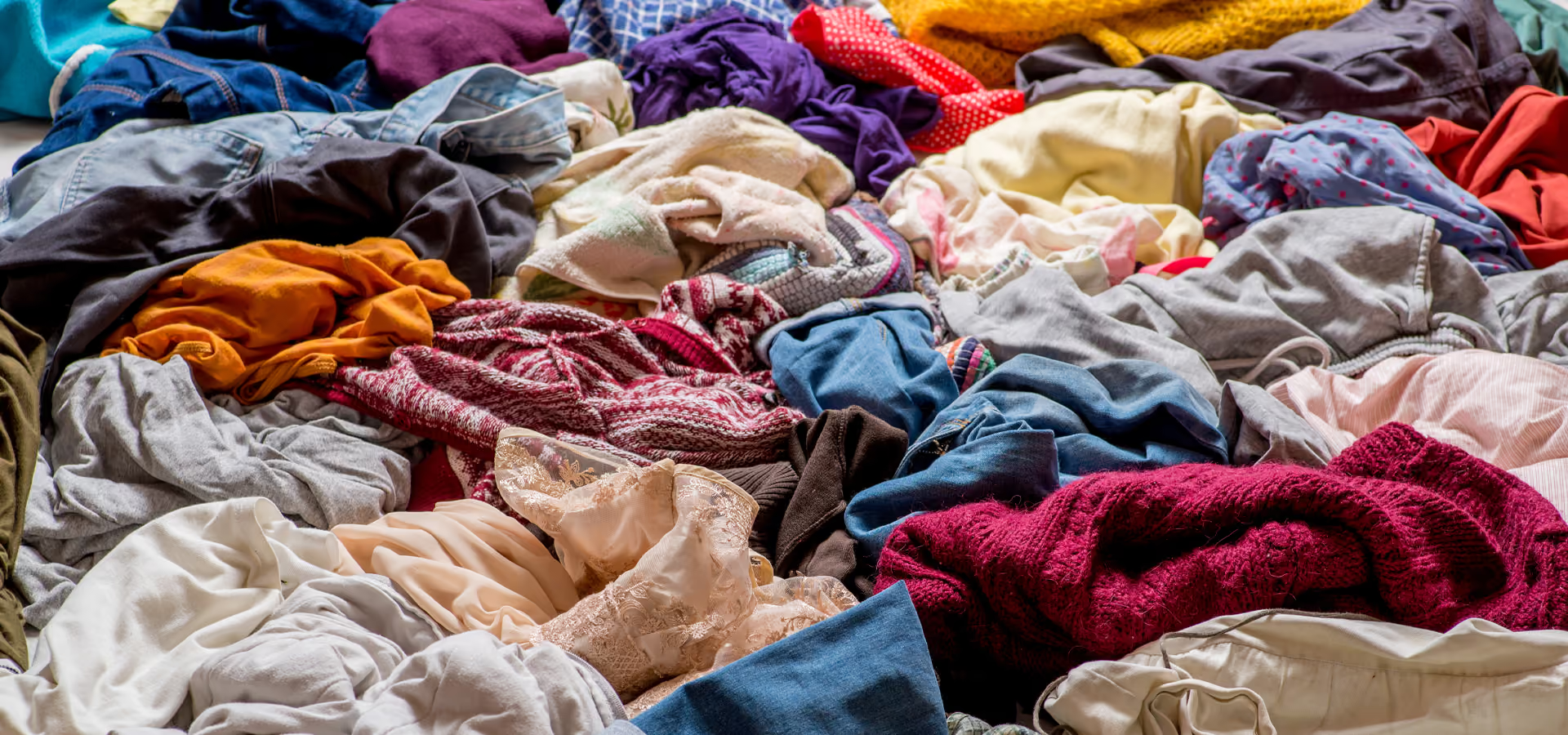

Textile recycling in Europe has moved from ambition to obligation. Since 1 January 2025, every EU Member State has been required to collect textiles separately from other household waste. In October 2025 the revised Waste Framework Directive entered into force, establishing common rules for extended producer responsibility across all 27 Member States and giving governments 20 months to transpose it and 30 months to have producer responsibility schemes running.
The collection side of the problem is therefore, legally speaking, solved. The harder question is what happens next. Collected textiles only become recycled material if someone can determine what each item is made of, at volume, quickly enough and accurately enough for the output to be worth something. That is a sorting and identification problem, and it is where the bottleneck now sits.
This article looks at the state of textile recycling in Europe, why fibre identification determines whether the industry scales, who does what across the value chain, and what operators planning capacity need to think about.
What Is Textile Recycling?
Textile recycling is the recovery of used textiles and textile waste into materials that can be used again. It covers a spectrum of outcomes that are often collapsed into a single word:
- Reuse — the garment continues life as a garment, resold or redistributed. This retains the most value and requires the least processing.
- Repair and repurposing — the item is restored or converted into a different product.
- Mechanical recycling — fibres are shredded and respun. Fibre length shortens, so quality degrades with each cycle, and the input has to be reasonably homogeneous.
- Chemical recycling — polymers are broken down and reconstituted. This can produce virgin-quality material, but it is highly sensitive to contamination and generally requires a single, known polymer type as input.
- Energy recovery and disposal — incineration or landfill, the outcomes the regulatory framework is designed to reduce.
The two recycling routes both depend on knowing the input. Mechanical recycling of mixed fibres produces material with limited applications. Chemical recycling of an unidentified feedstock either fails or produces a contaminated output. In both cases the value of the recycled material is set upstream, by the accuracy of sorting.
Where the Rules Now Stand
The regulatory position has changed substantially and is worth stating precisely, because a great deal of published material still describes it as forthcoming.
Separate collection is already mandatory. The obligation took effect on 1 January 2025. Member States must have systems in place to collect textiles separately from mixed household waste. For context on how much of a change that represented: before the deadline, only around half of EU Member States had separate textile collection in place at all, and most of those systems were designed to capture reusable garments rather than material for recycling.
Extended producer responsibility is now EU law. The targeted revision of the Waste Framework Directive — Directive (EU) 2025/1892 — entered into force on 16 October 2025. Every Member State must establish an EPR scheme for textiles and footwear following common EU rules. Producers pay a fee for each product they place on the market, and those fees finance collection and the subsequent management of what is collected: reuse, preparation for reuse, recycling, and disposal.
The fees are eco-modulated, meaning they are adjusted according to sustainability criteria such as those developed under the Ecodesign for Sustainable Products Regulation, taking account of factors including durability and recyclability. Fee revenue is also directed towards consumer information and towards research and development in product design and waste management.
Sorting is now a legal precondition for shipment. This is the provision with the most direct consequences for processing capacity, and it deserves emphasis. Under the revised Directive, all separately collected textiles are classified as waste, which establishes a uniform interpretation across Member States of what counts as "waste" rather than "used" textiles. Member States must ensure that separately collected textiles undergo sorting operations before any possible shipment, specifically to prevent waste being mislabelled and exported as reusable material. Unsorted textile waste falls under the Waste Shipment Regulation.
The practical effect is that sorting has moved from good practice to a legal requirement standing between collection and any onward movement of the material. Exporting an unsorted collection stream as reusable goods is no longer available as a route.
Implementation runs to 2027 and 2028. Member States have 20 months from entry into force to transpose the Directive into national law, and 30 months to establish EPR schemes for textiles and footwear. National progress varies widely: some countries already have operational schemes, several are in advanced legislative stages, and others are still in policy discussion with implementation expected in 2027 or 2028. France has run a mandatory textile EPR scheme since 2007, and the revised Directive effectively extends that model across the Union.
Social economy operators are treated differently. Enterprises engaged in second-hand textile collection and management are exempt from EPR obligations, may operate their own collection systems, and can have their textile waste managed at no cost by producer responsibility organisations.
The sector this applies to is substantial. EU textile and clothing generated a turnover of €170 billion in 2023 across 197,000 companies employing 1.3 million people. The practical consequence for anyone planning sorting or recycling capacity is that demand is now underwritten by law rather than by voluntary commitment. Volumes are arriving, and they have to be sorted.
The Capacity Gap
The figures behind the regulation describe the gap it has created.
According to European Environment Agency data, EU Member States generated around 6.94 million tonnes of textile waste in 2022 — roughly 16 kg per person. That total has been broadly stable since 2016, so this is not a problem that is growing so much as one that has not been addressed.
What has changed, slowly, is how much of it gets captured. The EU capture rate for household textile waste rose by 4.3 percentage points between 2016 and 2022, reaching just under 15%. Put the other way round: 85% of household textile waste was still going into mixed waste, from which it can be neither reused nor recycled. Counting separate collection from households together with all economic activities, 4.6 kg per person was collected separately in 2022 against 11.1 kg per person that was not.
The treatment data shows where the uncollected and unsorted material ends up, and the trend is instructive. Landfilling of textile waste in Europe fell from 21% in 2010 to 12% in 2022 — genuine progress. Over the same period, incineration rose from 10% to 14%. Exports of used textiles have nearly tripled since 2000, from a little over 550,000 tonnes to 1.4 million tonnes by 2019, and remained at 1.4 million tonnes in 2023.
This is the pattern the EEA warned about: material diverted from landfill is not automatically recycled. Without sorting capacity, it is burned or shipped. The revised Directive's sorting requirement is aimed squarely at closing the export route, which leaves domestic sorting capacity as the constraint that determines whether the framework achieves anything.
And sorting capacity is limited less by conveyors and buildings than by the ability to identify material accurately at throughput.
Why Identification Is the Bottleneck
Sorting textiles by colour, size, and visible condition is comparatively straightforward and can be done by hand. Sorting by fibre composition cannot.
The reason is that fibre content is not visible. A garment's appearance tells you about its dye and its construction, not about the polymer or natural fibre underneath. Two black t-shirts, one cotton and one polyester, look the same. Care labels would in principle answer the question, but at recycling volumes they are unreadable in practice — faded, cut out, missing, in the wrong language, or simply inaccurate. Manual sorting by fibre type is not viable at the scale the regulation implies.
The problem is compounded by blends. A significant share of the garments arriving at a sorting facility are not single-fibre items at all but mixtures — cotton-polyester in varying ratios, wool blends, cellulosics blended with synthetics, elastane present in small percentages across a wide range of products. For chemical recycling in particular, the presence and proportion of a second fibre changes whether an item is processable at all.
This is why optical identification has become central to the industry's scaling problem. A system that can determine composition without contact, on every item, at line speed, is what converts a collection stream into a set of clean, separable material fractions. The technical side of how that identification works — spectral signatures, blend detection, the software and machinery involved — is covered in our article on textile machine vision.
The Textile Recycling Value Chain: Who Does What
Searches for textile sorting companies usually reflect an attempt to work out who to talk to, and the answer depends on which part of the chain the question concerns. The industry is layered, and the layers do different things.
Collectors and municipalities gather textiles from households, collection points, and retail take-back schemes. Under the new framework this activity is increasingly financed through producer responsibility fees rather than municipal budgets.
Charities and social economy enterprises handle a substantial share of European collection, with reuse as the primary aim. Their distinct treatment under the revised Directive reflects how much of the existing infrastructure they represent.
Sorting operators are where collected material is separated into fractions — reusable garments by grade and market, and non-reusable material by fibre type for recycling. This is the layer under most pressure to expand, and the layer where identification technology is decisive.
Machine builders and system integrators design and supply the sorting lines themselves: conveyors, ejection mechanisms, control systems, and the sensing that drives them. These companies buy imaging technology rather than developing it.
Sensing and imaging suppliers provide the identification capability that sorting lines are built around. HySpex sits in this layer, as an original equipment manufacturer supplying camera modules and integrated imaging systems to the companies that build and operate sorting equipment.
Recyclers take sorted fractions and convert them into usable material through mechanical or chemical processing.
A working example of how these layers connect: Norsk Tekstilgjenvinning operates Norway's first textile-to-textile recycling facility in Sandefjord, and established Norsk Tekstilsortering as a subsidiary to run the sorting operation — deliberately co-located with the recycling plant so that collection, sorting, and recycling can be developed together. The fully automated sorter was built with Steco Miljø supplying the conveyor and sorting hardware, and Norsk Elektro Optikk, HySpex's parent organisation, supplying a complete hardware and software package for real-time textile classification, including the interface to the machine's PLC that controls the valves performing the physical separation. The system classifies between four and more than a hundred fibre types and mixtures, and identifies colour, brand logos, and accessories such as buttons, zips, and prints alongside fibre content. Our textile sorting use case covers the project in more detail.
The pattern is typical of the sector. No single company delivers a sorting facility. Identification technology, mechanical handling, control software, and operational expertise come from different specialists, and the integration is where projects succeed or fail.
From Collected Textiles to Recycled Feedstock
The route from a collection container to material a recycler will pay for runs through several decisions.
Reuse triage comes first, because reuse retains the most value. Items in wearable condition are graded and directed to resale or redistribution markets.
Fibre identification applies to everything that fails reuse triage. This is where composition is determined and where the quality of every downstream fraction is decided.
Fraction separation physically divides the stream according to identification results — typically by ejecting items into bunkers or onto secondary conveyors using pneumatic or mechanical actuators.
Contaminant removal handles the parts of a garment that are not textile: zips, buttons, rivets, and trims that interfere with both mechanical and chemical processing.
Feedstock preparation brings the sorted fraction to the specification the receiving recycler requires, which differs considerably between mechanical and chemical routes.
Each stage inherits the accuracy of the stage before it. A misidentified item contaminates a fraction; a contaminated fraction lowers the value of the recycled output or renders it unusable. This is the practical reason why identification accuracy, rather than throughput alone, is the parameter that determines whether a facility is commercially viable.
What Operators Planning Capacity Should Consider
For anyone specifying or expanding a sorting operation, a few questions tend to determine the outcome more than the rest.
How many fractions does the business model actually need? Separating four fibre categories is a materially different technical problem from separating a hundred. The answer should come from what receiving recyclers will pay for, not from what is technically possible.
What throughput does the volume forecast require? Regulatory-driven collection volumes are rising, and a line specified for today's intake may be undersized within a few years.
How accurately does composition need to be determined? Chemical recycling routes are less tolerant of contamination than mechanical ones. Tighter output specifications mean tighter identification requirements.
Are blends in scope? Detecting that an item is a blend, and estimating the ratio, is a harder problem than assigning it to a single-fibre class — and often the more commercially significant one.
How will the identification system connect to the machinery? Sensing that cannot deliver a decision to the ejection mechanism within the right time window does not sort anything. Integration with existing control systems is a specification requirement, not an implementation detail.
What happens when the input stream changes? Garment composition shifts as fashion and materials change. A system whose models can be updated and transferred between machines will age better than one that cannot.
Our overview of industrial machine vision covers the integration and specification side of these questions across industries, and the HySpex industrial solutions page sets out how the imaging layer is delivered.
FAQ – Textile Recycling
What is textile recycling?
Textile recycling is the recovery of used textiles and textile waste into materials that can be used again. It spans reuse of garments, repair and repurposing, mechanical recycling where fibres are shredded and respun, and chemical recycling where polymers are broken down and reconstituted. Both recycling routes depend on knowing the fibre composition of the input material.
Is textile collection now mandatory in the EU?
Yes. Since 1 January 2025, EU Member States have been required to collect textiles separately from mixed household waste. The revised Waste Framework Directive — Directive (EU) 2025/1892, in force since 16 October 2025 — additionally establishes EU-wide extended producer responsibility for textiles, with Member States given 20 months to transpose it and 30 months to set up producer responsibility schemes. The same Directive also requires that separately collected textiles be sorted before any shipment, which prevents unsorted material being exported as reusable goods.
Why is fibre identification difficult?
Fibre content is not visible. A garment's appearance reflects its dye and construction rather than the material underneath, so two visually identical items can be entirely different fibres. Care labels are unreliable at recycling volumes because they are frequently faded, removed, missing, or inaccurate. Blended fabrics add further difficulty, since the presence and proportion of a second fibre affects whether an item can be processed at all.
What do textile sorting companies do?
Sorting operators separate collected textiles into fractions: reusable garments graded by condition and market, and non-reusable material divided by fibre type for recycling. They sit between collectors and recyclers in the value chain, and their output quality determines what recyclers can do with the material. They typically buy sorting lines from machine builders and integrators, who in turn source identification technology from imaging suppliers.
Can mixed fibres be recycled?
Mixed fibres can be mechanically recycled, but the resulting material has more limited applications than single-fibre input. Chemical recycling is considerably less tolerant, generally requiring a known, single polymer type. This is why detecting blends — and where possible estimating the ratio — matters commercially as much as identifying single-fibre items.
Where does HySpex fit into textile recycling?
HySpex is an original equipment manufacturer of hyperspectral imaging systems. We supply camera modules and integrated imaging solutions to the companies that build and operate textile sorting equipment, rather than operating sorting facilities ourselves. Norsk Elektro Optikk, our parent organisation, contributed the imaging technology to a fully integrated optical textile sorter developed with Norsk Tekstilgjenvinning and Steco Miljø.
Discuss Identification Capacity for Your Operation
At HySpex we develop hyperspectral imaging systems used for material identification in recycling, sorting, and industrial inspection, supplied either as camera modules for integration or as complete imaging solutions with real-time processing software. For teams that prefer to own the software layer, a platform-independent SDK is available.
If you are planning sorting capacity, specifying a line, or evaluating what fibre resolution your business model requires, a technical conversation about throughput, fraction count, and integration is usually the most useful place to start.