
Industrial Mineral Quarries
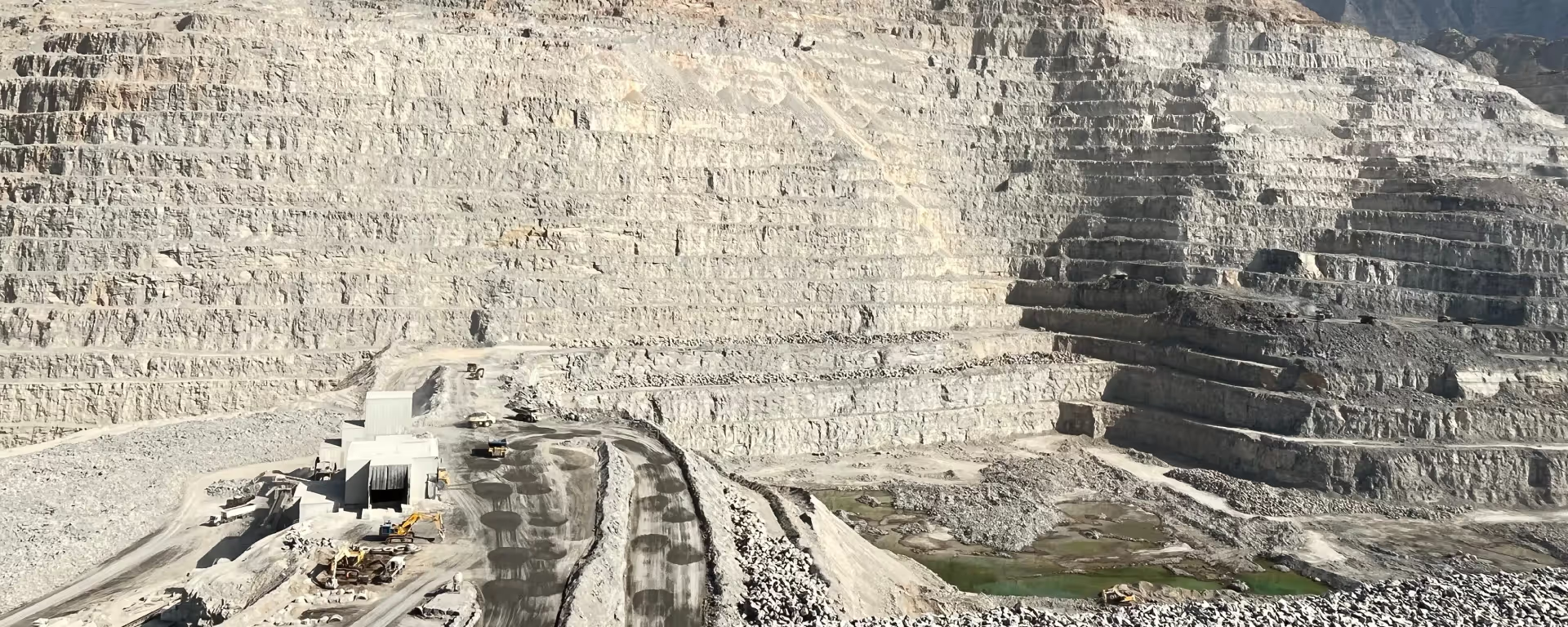

Increasing Efficiency, Sustainability and Competitiveness with Hyperspectral Imaging
In the world of volume mining, where limestone quarries churn out a staggering 200,000 tons of material each day, precision is secondary to a sound understanding of quality distribution over large volumes of material.
The need for quality control however, becomes all the more imperative with razor-thin profit margins. Hyperspectral imaging can aid the way we manage the extraction process in volume operations, in this case limestone quarries, and reconcile block model quality and the reality of the material that ends up in the crusher. Traditionally, quality control in mining operations relies on manual sampling and testing, which is labour-intensive, time consuming, and prone to human error.
Hyperspectral imaging offers a proven alternative by providing fast, comprehensive data on the chemical composition and physical properties of mined materials. One of the key advantages of hyperspectral imaging lies in its ability to capture detailed spectral information across hundreds of narrow wavelength bands. This enables mining engineers to analyse small shift in patterns ultimately identifying mineralogy, or substitution of elements and to pick up on quality parameters e.g. indicating changing magnesium or silica content.
Moreover, information derived from hyperspectral imaging can be seamlessly integrated into the existing block model, ensuring that the extraction and transport of material are based on precise geological assumptions.

Figure 1: An illustration demonstrating various areas in a volume mining operation where hyperspectral cameras can be used.
Integrating hyperspectral imaging, mining operators can identify high-quality zones, optimise blasting patterns, and minimise material transported adjustments – ultimately maximising profitability and decreasing the needed resources to achieve a high-quality product. In practical terms, hyperspectral cameras can be strategically deployed at various points along the mining process, including on trucks, mine faces, conveyors or as mobile labs near drillers.
For instance, as trucks haul freshly blasted rock from the quarry face to the crushers, hyperspectral cameras mounted above off-loading facilities can rapidly assess the surface mineral content of the truckload in real-time. This allows operators to quickly identify any deviations from the desired quality specifications and take corrective action as needed enabling a proactive approach to quality control. By intervening promptly to address such issues, mining companies can minimise product rejections, optimise resource utilization, and enhance customer satisfaction.

Figure 2: Mineral mapping of three different trucks, believed to be low-quality limestone. Each truck is shown in false-colour RGB on the left and with the overlaid mineral map on the right. Truck 1 shows high-quality limestone content on the surface.
We tested the scanning of a quarry face as well as several truck loads in a large limestone quarry to demonstrate the technology using a HySpex SWIR-384 camera. Figure 2 shows the truck load surfaces and mineral mapping based on USGS PRISM MICA algorithm, integrated in Prediktera’s Breeze GEO software. While all of these trucks were believed to be low quality limestone, the scans show that higher quality limestone has wrongly found its way to this crusher.

Figure 3: A: Mineral map of the mine face. B: General setup of tripod-based scanning using a HySpex SWIR-384 camera. C: Approximate location of the map shown in A on the quarry face.
Figure 3 shows the scanning of a quarry face at the intersection of the overburden and a higher quality limestone bank underneath. While the hyperspectral imaging clearly shows the overburden dominated by mica (orange) and carbonate + clay mixtures, the lower bank shows dolomite and calcite mixtures.
We believe that as the mining industry continues to evolve, harnessing the full potential of hyperspectral imaging will be instrumental in driving efficiency, sustainability, and competitiveness in volume mining operations. While hyperspectral imaging will not replace traditional methods, it is worth considering which questions and existing blind spots it can reveal and solve in your operation.
Interested in learning more about how hyperspectral imaging can benefit your quarry workflow?
Get in touch with one of our hyperspectral specialists by filling out a form on our contact page! We offer many turnkey solutions for mining and raw material-related studies as well as other scientific and industrial applications.