
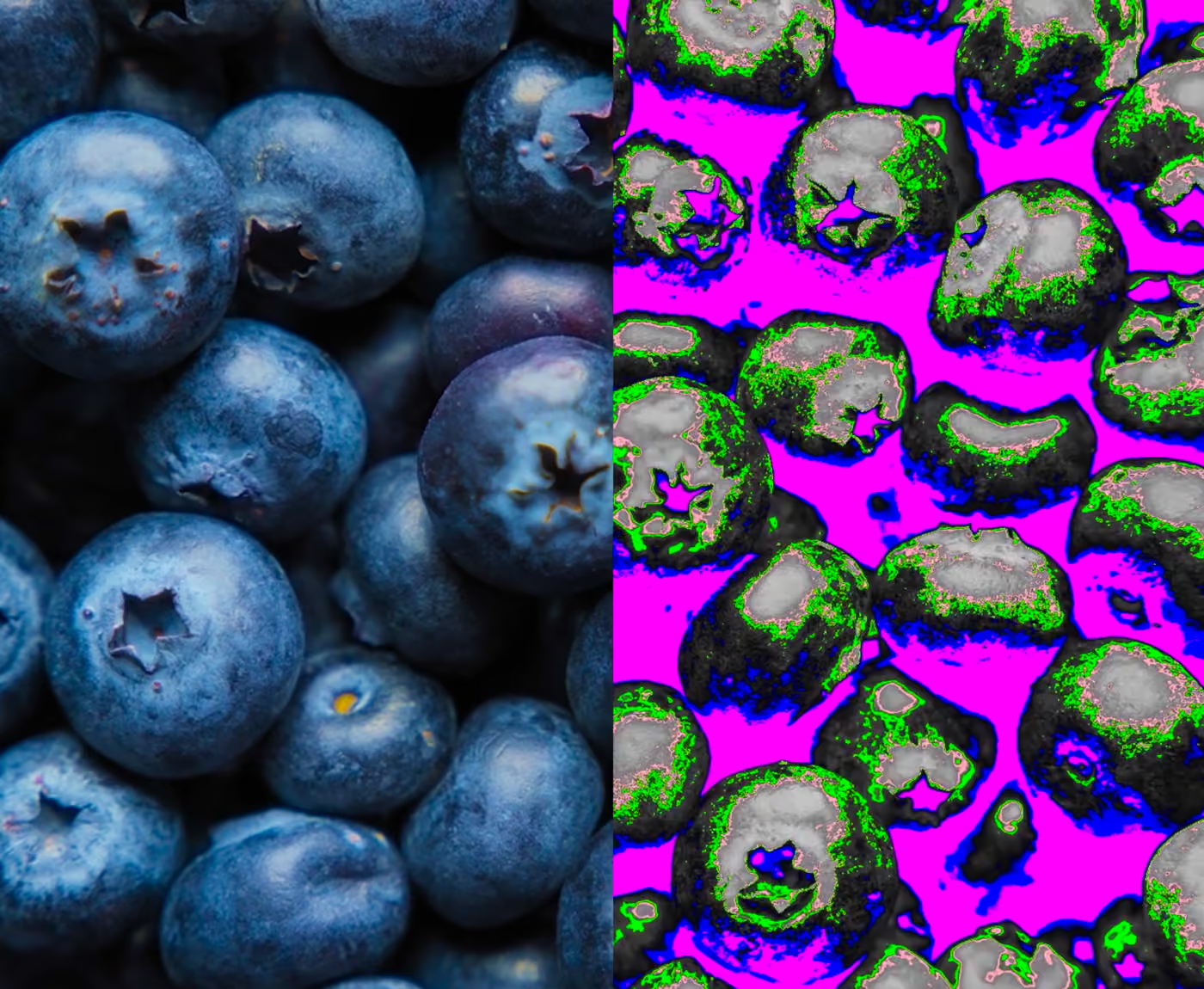

A spectral photo is not a standard consumer photography term, but it is often used to describe an image that contains more information than a conventional color photograph. In technical imaging, a spectral photo usually refers to a spectral image captured across multiple wavelengths, allowing the image to reveal material, chemical, or physical differences that are not visible in normal RGB photography.
In other words, a spectral photo is not just a picture of how something looks. It is a data-rich image that shows how an object or surface interacts with light across different parts of the spectrum.
For researchers, engineers, and industrial users, this type of image is better understood through spectral imaging and hyperspectral imaging.
A Spectral Photo vs a Normal Photo
A standard digital photograph records light in three broad channels: red, green, and blue. This is enough to reproduce visual appearance for the human eye, but it provides limited analytical information.
A spectral photo, by contrast, captures light in more than three channels. Depending on the system, it may contain:
- a small number of selected wavelength bands
- many narrow and contiguous spectral bands
- information extending beyond visible light into near-infrared or shortwave infrared regions
This added spectral information makes it possible to distinguish objects or materials that may look identical in a normal image.
What Makes a Spectral Photo Different?
The defining feature of a spectral photo is that each part of the image contains wavelength-based information. Instead of showing only visual color, the image reflects how a surface absorbs, reflects, or emits light across a broader spectral range.
That means a spectral photo can be used to reveal differences related to:
- material composition
- moisture or chemical variation
- surface condition
- biological or environmental properties
- early defects or changes not visible in RGB images
This is why spectral imaging is widely used in scientific, industrial, environmental, and remote sensing applications.
From Spectral Photo to Hyperspectral Image
In advanced optical sensing, the term spectral photo is often most closely related to a hyperspectral image.
A hyperspectral image records a full or near-continuous spectrum for each pixel in the scene. Rather than storing only color values, it stores detailed spectral measurements across many wavelength bands. This transforms the image into a structured dataset that can be analyzed quantitatively.
So while “spectral photo” is a more informal or search-friendly term, the technical equivalent in many professional contexts is a hyperspectral image or spectral image.
How a Spectral Image Is Created
A spectral image is typically generated using a specialized imaging system rather than a conventional camera. In hyperspectral imaging, the system captures both spatial and spectral information at the same time.
Many high-performance systems use an imaging spectrometer and a pushbroom scanning method. In this approach:
- a narrow line of the scene is imaged at a time
- light from that line is separated into wavelengths
- the sensor records both spatial and spectral data
- adjacent lines are combined to build a full image cube
The result is an image in which every pixel contains a spectral signature, allowing very detailed analysis of the scene.
Why Spectral Photos Matter
A spectral photo is valuable because it can reveal information that is hidden in standard imaging. Two objects may have the same visible color but very different spectral behavior. This difference can be critical in applications where appearance alone is not enough.
Examples include:
- identifying defects in industrial materials
- evaluating food quality
- analyzing vegetation and crop condition
- distinguishing minerals or geological features
- supporting biomedical or laboratory research
In all of these cases, the purpose of the image is not only to document appearance, but to support measurement and interpretation.
Spectral Photos in Scientific and Industrial Imaging
In technical environments, spectral photos are not treated as ordinary photographs. They are analytical images used to extract measurable information.
That is why system quality matters. Factors such as:
- spectral resolution
- spatial resolution
- optical sharpness
- calibration quality
- system stability
all influence how useful the resulting image will be.
A spectral image intended for scientific or industrial analysis must provide reliable data, not just a visually interesting result.
Beyond the Visible Spectrum
One of the key advantages of spectral imaging is that it can operate beyond the visible range. While a normal camera is limited to the wavelengths humans can see, advanced spectral imaging systems can capture information in the near-infrared and shortwave infrared regions as well.
This is especially important because many materials show highly informative spectral features outside visible light. A spectral photo captured across these broader wavelength ranges can therefore reveal far more than a conventional image.
Is a Spectral Photo the Same as Hyperspectral Imaging?
Not always — but the concepts are closely related.
A spectral photo is a broad, informal way of describing an image that contains spectral information. Hyperspectral imaging is a more specific technical method that captures many narrow wavelength bands and produces highly detailed spectral data for each pixel.
So in practical terms:
- a spectral photo may refer to a spectral image in general
- a hyperspectral image is a high-information, measurement-grade form of spectral image
For professional users, hyperspectral imaging is often the most precise framework for understanding what a spectral photo can really mean.
Spectral Photos as Measurement Images
The most important shift is this: a spectral photo should not be understood as just a better-looking photo. It is better understood as an optical measurement image.
That distinction matters in research, quality control, remote sensing, and advanced inspection workflows. The value of the image lies in the spectral data it contains and in what that data can reveal about the object being observed.
As spectral imaging technologies continue to advance, the concept behind the spectral photo becomes increasingly relevant across fields where accurate, non-contact optical analysis is needed.
Explore Spectral Imaging for Analytical Applications
Understanding what a spectral photo represents is the first step toward understanding the value of advanced spectral imaging. In scientific, industrial, and remote sensing environments, the quality of the image depends on much more than visual appearance alone.
HySpex develops hyperspectral imaging systems designed for demanding applications where spectral precision, optical performance, and reliable data quality are essential.
If your work involves spectral analysis, image-based measurement, or advanced material identification, a technical discussion about imaging requirements can help clarify the right system approach.
FAQ – Spectral Photo
What is a spectral photo?
A spectral photo is an image that contains spectral information beyond standard RGB photography. It can reveal how materials or surfaces interact with light across multiple wavelengths.
Is a spectral photo the same as a hyperspectral image?
Not exactly. A spectral photo is a broader and more informal term, while a hyperspectral image refers to a more specific technical image that contains many narrow spectral bands and detailed per-pixel spectral data.
What can a spectral photo show that a normal photo cannot?
A spectral photo can reveal differences related to material composition, moisture, chemical variation, defects, or biological properties that may not be visible in a standard color image.
How is a spectral photo created?
A spectral photo is created using a spectral imaging system that captures light in multiple wavelength bands. In hyperspectral imaging, this is often done with an imaging spectrometer that records both spatial and spectral information.
Why are spectral photos useful in industry and research?
They provide data-rich images that support analysis, classification, and measurement. This makes them useful in quality control, food inspection, environmental monitoring, remote sensing, and scientific research.