
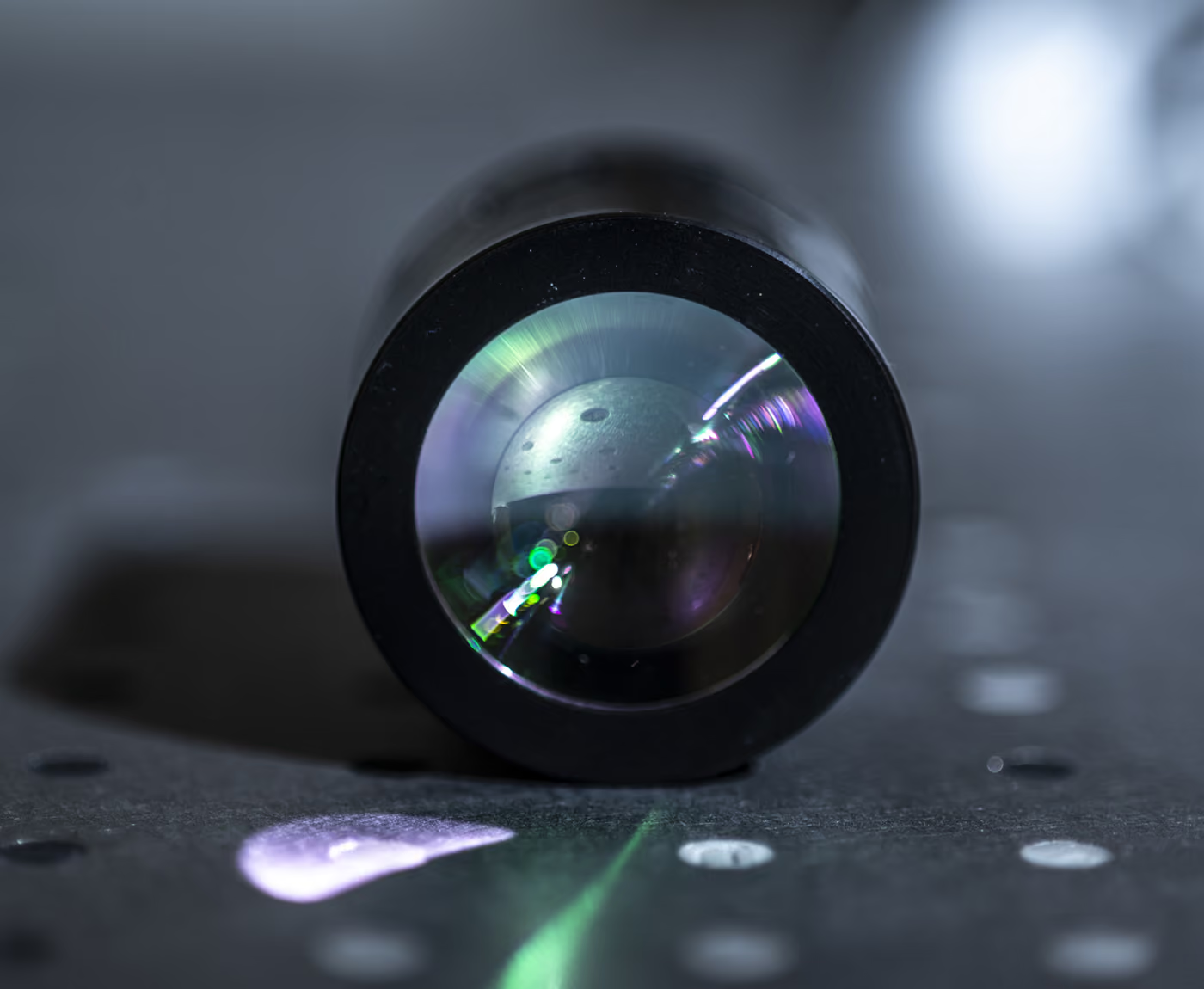

Multispectral imaging is a method of capturing image data in multiple discrete wavelength bands rather than only in the three broad visible channels used in conventional photography. Instead of recording just red, green, and blue, a multispectral imaging system measures selected spectral bands that may extend into the near-infrared, ultraviolet, or other non-visible parts of the spectrum, depending on the application.
This makes multispectral imaging technology valuable in applications where users need more information than a normal camera can provide, but do not necessarily require the dense spectral sampling of hyperspectral imaging. Multispectral systems are widely used in remote sensing, agriculture, environmental monitoring, industrial inspection, and scientific imaging because they allow surfaces, materials, and biological features to be distinguished based on their wavelength-dependent optical behavior.
What Is Multispectral Imaging?
At a practical level, multispectral imaging means capturing a scene in several distinct spectral channels. These channels are chosen based on the information needed for the task. In some systems, that might mean visible and near-infrared bands for vegetation analysis. In others, it might mean selected bands chosen to highlight moisture, material differences, or surface conditions. General remote-sensing references describe multispectral imaging as image acquisition in two or more wavelength ranges, often using a relatively small number of bands compared with hyperspectral systems.
A key point is that the bands are typically predefined and discrete, rather than near-continuous. That is what distinguishes multispectral imaging from hyperspectral imaging, where many narrow contiguous bands are used to produce much more detailed spectral data.
What Is a Multispectral Image?
A multispectral image is an image dataset that contains several separate wavelength channels for the same scene. Each image layer represents one selected band, and together those layers can be analyzed to reveal differences that are not visible in standard color imagery. Depending on the system, the final output may be visualized as false-color imagery, processed classification maps, or analytical image data used for measurement and interpretation.
This means a multispectral image is more than a photograph. It is an optical measurement image that can support classification, monitoring, and detection tasks by showing how different parts of the scene interact with light across selected spectral regions.
What Is a Multispectral Imaging Sensor?
A multispectral imaging sensor is the component that captures those separate wavelength bands. Different technical approaches can be used, including filtered detectors, beam-splitting optics, tunable filters, and line-scanning or area-scanning systems, depending on the intended application. In all cases, the sensor is designed to isolate and record data from specific spectral channels rather than recording only conventional RGB information.
From an application standpoint, the most important thing about a multispectral imaging sensor is not just the number of bands, but whether those bands are well chosen for the measurement task. A system intended for vegetation studies may prioritize different bands than one intended for document inspection, mineral mapping, or industrial process control. That is why multispectral imaging technology is often described in relation to the use case rather than just the hardware alone.
What Is a Multispectral Imaging System?
A multispectral imaging system includes more than the sensor itself. In practice, it often consists of:
- the imaging sensor or camera
- optics suited to the target application
- illumination or environmental control, where needed
- acquisition and control hardware
- data processing and visualization software
- sometimes platform integration, such as UAV, airborne, or industrial mounting systems
This system perspective matters because multispectral imaging is frequently used as part of a workflow rather than as a standalone camera function. In remote sensing and industrial inspection alike, the quality of the final output depends on calibration, stability, and how the sensor is integrated into the broader acquisition and analysis chain. HySpex makes this same broader point on the hyperspectral side, emphasizing that system quality and application fit matter more than isolated top-level specifications.
How Multispectral Imaging Technology Works
Multispectral imaging technology works by selecting specific wavelength bands and recording how much light is reflected, transmitted, or emitted in each one. Those band measurements are then combined into a multi-layer image dataset. Analysts can compare bands, calculate indices, or apply classification algorithms to identify patterns and differences in the scene.
This is especially useful because many surfaces and materials that appear similar in visible light behave quite differently in near-infrared or other spectral regions. A multispectral imaging system can therefore extract additional information that ordinary photography misses. NASA and USGS both describe remote sensing in terms of measuring reflected or emitted radiation to understand physical characteristics from a distance, and multispectral systems are a central part of that tradition.
Where Multispectral Imaging Is Used
Multispectral imaging is well established in several fields.
In remote sensing, it is used for land-cover mapping, vegetation analysis, water studies, and large-area monitoring. Earth-observation systems have used multispectral imaging for decades because selected bands can reveal information about soils, plants, and surface conditions that standard imagery cannot.
In agriculture, multispectral systems are commonly used to assess crop variability, vegetation vigor, and field conditions. Because certain vegetation properties are highly responsive in selected visible and near-infrared bands, multispectral imaging can support monitoring and decision-making at field scale.
In industrial and scientific imaging, multispectral methods can be used when a limited set of spectral features is enough to support classification or inspection. In these cases, the advantage is often a simpler dataset and a workflow that is easier to deploy than a full hyperspectral analysis pipeline. This is also why multispectral imaging can be attractive where speed, simplicity, or lower data volumes are important.
Multispectral Imaging vs Standard Photography
A conventional photograph is designed to reproduce how a scene looks to the human eye. A multispectral image is designed to capture how the scene behaves optically across selected wavelength bands. That is a very different goal.
A normal photo is useful for documentation and visual interpretation. A multispectral image is useful for measurement, comparison, and analytical interpretation. This distinction is important in technical and scientific environments, where the value of the image lies in what it can reveal about materials, surfaces, and conditions rather than just visual appearance.
Multispectral Imaging and Hyperspectral Imaging
Multispectral imaging is closely related to hyperspectral imaging, but the two should not be treated as interchangeable. Multispectral systems usually measure a relatively small number of selected bands, while hyperspectral systems measure many narrow contiguous bands, often producing far richer spectral detail. NASA training material summarizes this by noting that multispectral imagery typically refers to about 3 to 10 bands, while hyperspectral imagery uses hundreds or even thousands of narrower bands.
That difference affects both capability and system design. Multispectral imaging can be highly effective when the right bands are known in advance and the goal is targeted discrimination. Hyperspectral imaging becomes more relevant when the task requires detailed material characterization, more flexible spectral analysis, or the ability to detect subtle spectral features across a broader, denser dataset. HySpex’s own positioning is built around this higher-information hyperspectral end of the spectrum.
Why Multispectral Imaging Still Matters
Even though hyperspectral imaging offers more spectral detail, multispectral imaging technology remains highly relevant. In many workflows, a carefully designed multispectral system provides enough information to solve the task with less data, faster processing, and simpler deployment. That makes multispectral imaging practical for many operational applications where a narrower but targeted spectral approach is sufficient.
At the same time, understanding multispectral imaging is useful for users evaluating whether their application can be solved with a smaller set of spectral bands or whether they need the richer data produced by hyperspectral systems. That is often the real decision point in advanced spectral imaging.
Understanding Multispectral Imaging in a Broader Spectral Imaging Context
The best way to understand multispectral imaging is to place it within the broader family of spectral imaging methods. It sits between conventional RGB imaging and full hyperspectral imaging, offering more spectral information than standard photography while remaining simpler than a high-band hyperspectral measurement system.
For users exploring spectral sensing, a multispectral image, multispectral imaging sensor, or multispectral imaging system is often part of a wider decision process about data richness, workflow complexity, and application requirements. And for technically demanding environments where selected bands are not enough, that evaluation may naturally lead toward hyperspectral imaging technology.
Evaluate the Right Spectral Imaging Approach for Your Application
Choosing between standard imaging, multispectral imaging, and more advanced hyperspectral imaging depends on the level of spectral detail your application requires. Band selection, data quality, workflow complexity, and analysis goals all shape the right system approach.
HySpex develops hyperspectral imaging systems for demanding scientific, industrial, and remote sensing applications where higher spectral fidelity and analytical depth are important.
If you are assessing spectral imaging options for research, inspection, or measurement tasks, a technical discussion about your requirements is often the best place to start.
FAQ – Multispectral Imaging
What is multispectral imaging?
Multispectral imaging is a method of capturing image data in multiple discrete wavelength bands rather than only in standard RGB channels. It allows additional optical information to be extracted from a scene for analysis and interpretation.
What is a multispectral image?
A multispectral image is an image dataset made up of several selected spectral bands of the same scene. These bands can be analyzed together to reveal material or surface differences not visible in conventional photography.
What is a multispectral imaging sensor?
A multispectral imaging sensor is a sensor designed to capture several predefined wavelength bands rather than only visible RGB information. Different sensor architectures can be used depending on the application.
What is the difference between multispectral and hyperspectral imaging?
Multispectral imaging uses a limited number of discrete bands, while hyperspectral imaging uses many narrow contiguous bands and provides much richer spectral detail.
Where is multispectral imaging used?
It is widely used in remote sensing, agriculture, environmental monitoring, scientific imaging, and some industrial workflows where selected spectral bands provide enough information for the task.