
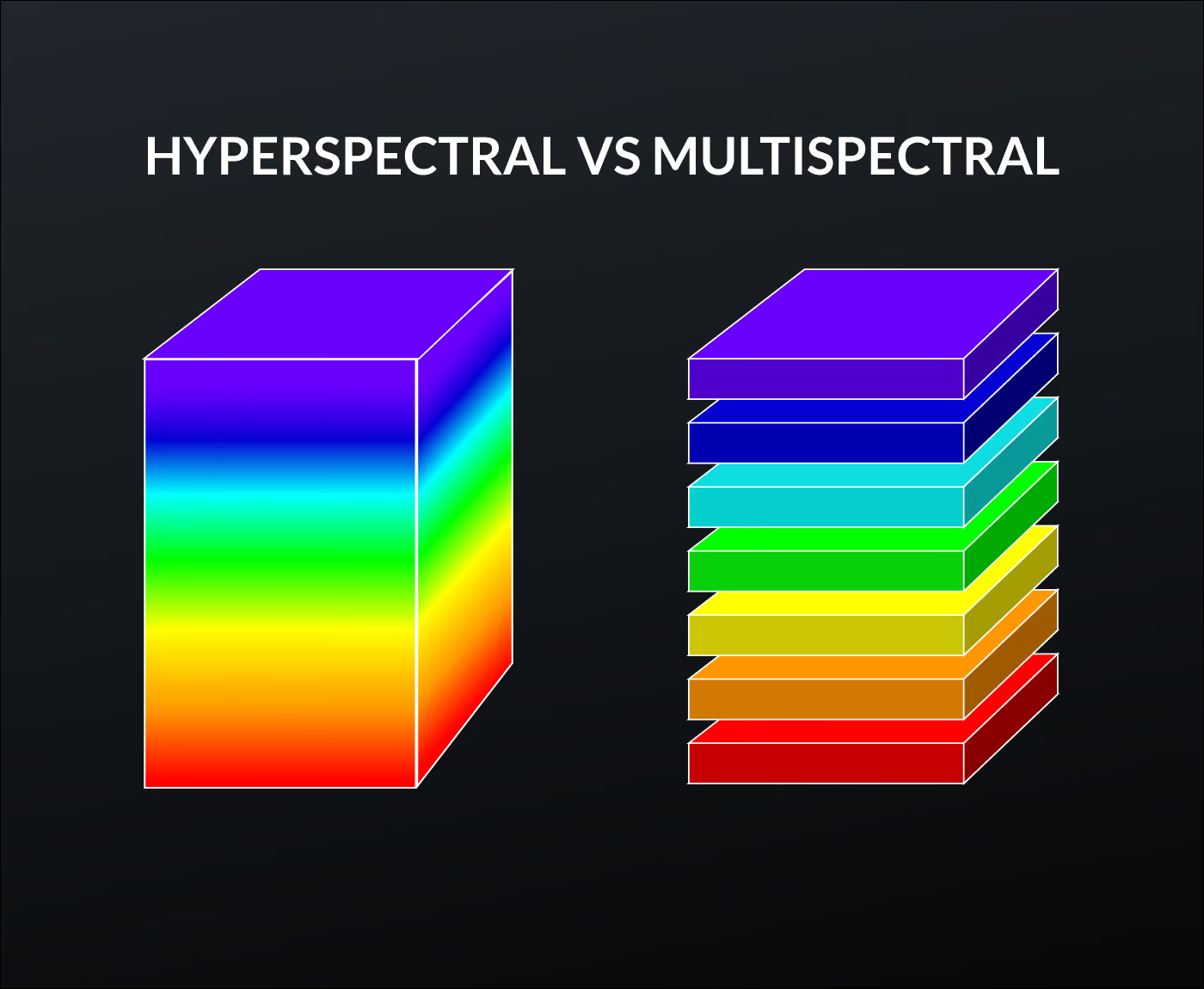

Understanding the difference between multispectral and hyperspectral imaging is essential when selecting an optical sensing technology for scientific, industrial, or remote sensing applications. Although both approaches belong to the broader field of multispectral and hyperspectral imaging, they differ significantly in spectral detail, data structure, and analytical capability.
This guide explains how multispectral and hyperspectral imaging work, what separates them, and when each approach is most suitable.
What Is Multispectral Imaging?
To understand multispectral vs hyperspectral, we first define multispectral imaging.
Multispectral imaging captures images in a limited number of discrete wavelength bands. These bands are typically broad and separated from each other. A multispectral system might measure light in:
- Visible bands (red, green, blue)
- Near-infrared
- A few additional selected regions
Each band provides general information about how a surface reflects or emits light, but the spectral sampling is sparse.
Multispectral systems are commonly used for:
- Basic vegetation analysis
- Land cover classification
- General monitoring tasks
They provide useful data, but with limited spectral detail.
What Is Hyperspectral Imaging?
Hyperspectral imaging extends this concept significantly. Instead of capturing a few broad bands, hyperspectral systems measure light in many narrow, contiguous spectral bands — often dozens to hundreds.
Each pixel in a hyperspectral image contains a nearly continuous spectrum. This allows materials to be characterized based on subtle spectral features related to their chemical and physical properties.
Hyperspectral imaging systems are built around imaging spectrometer technology and are designed as analytical instruments capable of:
- Precise material identification
- Quantitative analysis
- Detection of subtle differences invisible to standard imaging
Differences Between Multispectral and Hyperspectral Imaging
The main difference between multispectral and hyperspectral imaging lies in how spectral information is sampled. Multispectral systems capture a limited number of broader, separated wavelength bands, while hyperspectral systems measure many narrow, contiguous bands. This affects how much spectral detail is available for classification, identification, and quantitative analysis.
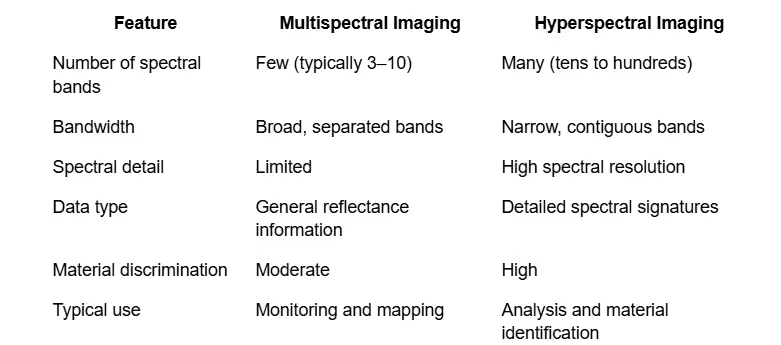
The core difference in hyperspectral vs multispectral lies in spectral resolution and information content.
Why Spectral Resolution Matters
Many materials that look identical in color images — and even in multispectral data — can be distinguished using hyperspectral imaging. This is because narrow spectral features, such as absorption peaks linked to molecular bonds, are only resolved when the spectrum is sampled densely.
For applications requiring:
- Chemical or mineral identification
- Precise quality control
- Scientific measurements
hyperspectral imaging provides a level of detail that multispectral systems cannot.
Data Volume and System Complexity
The increased spectral detail in hyperspectral systems comes with higher data volume and more advanced system design requirements. Optical quality, calibration stability, and spectral accuracy are critical, as the data is often used for quantitative analysis.
Manufacturers of advanced hyperspectral imaging systems, such as HySpex, focus on delivering stable, well-calibrated instruments that maintain spectral integrity over time. This level of performance is essential when hyperspectral data supports research or industrial decision-making.
When to Choose Multispectral vs Hyperspectral
Multispectral imaging is often sufficient when the goal is broad classification or monitoring and when system simplicity and lower data rates are important.
Hyperspectral imaging is preferred when:
- Subtle material differences must be detected
- Spectral features must be analyzed in detail
- Quantitative, research-grade data is required
The choice depends on whether the task is primarily observational or analytical.
Hyperspectral and Multispectral Imaging in Modern Sensing
Both technologies play important roles in remote sensing and optical measurement. Multispectral imaging offers a practical solution for many monitoring applications, while hyperspectral imaging enables deeper material insight.
As sensing technologies evolve, hyperspectral systems continue to expand the boundaries of what can be measured optically, supporting scientific research, industrial inspection, and advanced remote sensing.
Choose the Right Spectral Imaging Approach for Your Application
Selecting between multispectral and hyperspectral imaging depends on the level of spectral detail required, the nature of the materials being analyzed, and the overall system objectives.
HySpex develops advanced hyperspectral imaging systems designed for applications where spectral precision, stability, and data quality are critical. Our team works with researchers, industrial users, and system integrators to evaluate performance requirements and system configurations for demanding spectral measurement tasks.
If your application involves material identification, quantitative analysis, or high-resolution spectral data, we can provide guidance on the capabilities and considerations of hyperspectral imaging technology. Feel free to contact us for more information.
FAQ – Hyperspectral vs Multispectral Imaging
What is the difference between multispectral and hyperspectral imaging?
The main difference between multispectral and hyperspectral imaging is the number and width of the spectral bands. Multispectral imaging uses a limited number of broader wavelength bands, while hyperspectral imaging uses many narrow, contiguous bands that provide more detailed spectral information for analysis and material identification.
What is multispectral imaging used for?
Multispectral imaging is commonly used for general monitoring, land cover classification, vegetation analysis, and mapping tasks where broad spectral information is sufficient.
Why is hyperspectral imaging more detailed?
Hyperspectral imaging measures light in many narrow bands, allowing detection of subtle spectral features linked to material composition. This enables more precise classification and quantitative analysis than multispectral imaging.
Does hyperspectral imaging always replace multispectral imaging?
No. Multispectral imaging remains useful when simpler systems, lower data volumes, and general classification tasks are sufficient. Hyperspectral imaging is chosen when higher spectral resolution and analytical capability are required.
Which system is better for scientific measurements?
For applications requiring detailed material characterization and quantitative spectral analysis, hyperspectral imaging systems are generally more suitable due to their higher spectral resolution and data richness.