
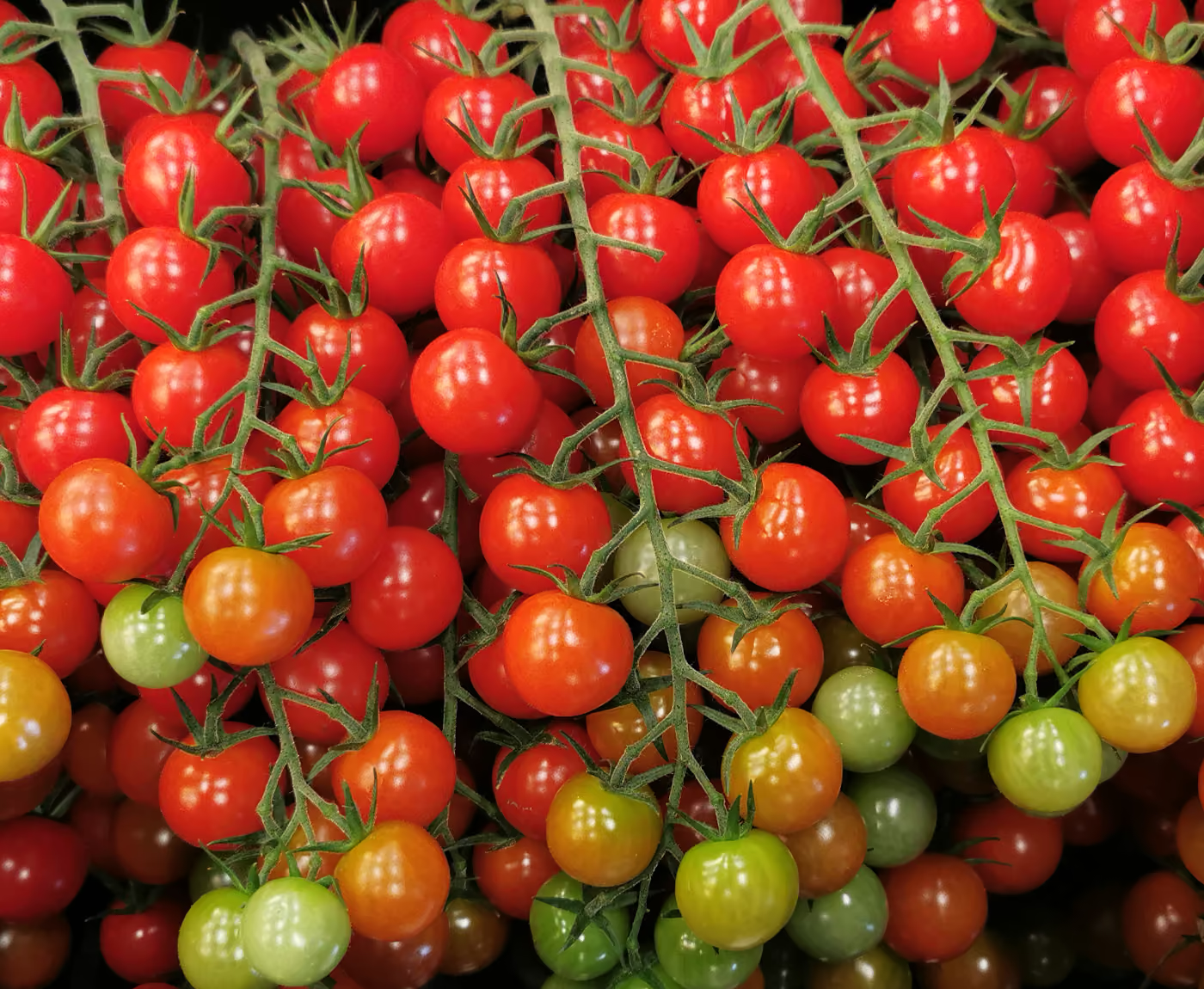

Hyperspectral imaging in food industry applications is becoming an increasingly important tool for quality inspection, sorting, and process control. By combining imaging and spectroscopy, hyperspectral systems make it possible to assess food products based not only on appearance, but also on their spectral and chemical properties.
For producers working with high volumes, strict quality requirements, and demanding consistency targets, hyperspectral imaging food applications offer a non-destructive and data-rich approach to inspection. The technology supports objective, repeatable analysis in both laboratory and in-line environments, helping bridge the gap between visual inspection and more time-consuming analytical testing.
Why Traditional Food Inspection Has Limitations
Food quality assessment has traditionally depended on visual inspection. While experienced operators can identify many defects, this approach has several limitations:
- it can be subjective
- it depends on operator experience
- it is labour-intensive
- it can be difficult to scale across full production volumes
- it cannot reveal many non-visible quality attributes
Conventional machine vision systems improve automation, but RGB imaging is still limited to visible appearance. In many food applications, important information related to internal condition, chemical composition, or early-stage deterioration is not visible in standard colour images.
This is where hyperspectral imaging in food industry workflows offers a clear advantage.
What Hyperspectral Imaging Adds to Food Analysis
A hyperspectral imaging system records a spectrum for every pixel in the image. Instead of only measuring visible colour, it captures detailed spectral information across many narrow wavelength bands. This enables the system to detect subtle differences in how food products reflect and absorb light.
In food applications, this means hyperspectral imaging can be used to evaluate:
- colour and surface uniformity
- texture and firmness-related features
- bruising and surface damage
- defects and contamination
- early spoilage or rot
- moisture-related variation
- chemical and nutritional indicators
Because the method is non-invasive, products can be analysed without damaging them. This makes hyperspectral imaging food systems attractive for both research and operational production environments.
Hyperspectral Imaging for Real-Time Food Inspection
One of the strongest advantages of hyperspectral imaging in food production is its suitability for real-time analysis. High-speed systems can be integrated into conveying and sorting workflows, enabling automated quality assessment across large product volumes.
In such environments, the technology can improve both sorting speed and sorting accuracy. Rather than relying only on human observation or broad visual features, hyperspectral systems use spectral data to classify products based on measurable differences.
This supports more consistent decisions in tasks such as:
- separating acceptable and non-acceptable products
- identifying damaged or contaminated items
- grading products by quality-related parameters
- monitoring process consistency
With the right sensor and software combination, the transition from research to industrial implementation becomes significantly more practical.
Detecting Quality Attributes Beyond Human Vision
A major reason hyperspectral imaging in food industry applications continues to grow is that the technology can reveal information beyond what the human eye can detect.
In fruits and other fresh products, quality changes may begin before obvious visual symptoms appear. Early deterioration, internal variation, or subtle chemical differences may be difficult to detect at line speed using visual inspection alone.
Hyperspectral imaging can provide spectral signatures that correlate with both external and internal quality indicators. Depending on the product and application, these may include:
- taste- and flavor-related variation
- moisture content
- dry matter
- sugar-related properties
- acidity and pH
- vitamin-related characteristics
- other nutritional or compositional parameters
In some cases, hyperspectral data can also be correlated with wet lab analysis, allowing producers and researchers to build predictive models for non-destructive quality assessment.
Example: Hyperspectral Imaging for Berry Quality Inspection
A good example of hyperspectral imaging food applications is the assessment of berries and other small fruits. These products are especially sensitive to handling and storage, and their quality can deteriorate quickly if defects or spoilage are not identified early.
In blueberries, for example, rotten areas can be difficult to detect reliably at high speed through visual inspection or RGB imaging alone. Hyperspectral imaging offers a more sensitive alternative by capturing both spatial and spectral detail.
In the HySpex berry case, fresh blueberries with rotten sites were scanned using HySpex Classic VNIR-1800 and SWIR-384 cameras. Together, the system covered the 400–2500 nm spectral range and operated at speeds compatible with typical conveying and sorting systems. Using close-up optics, the setup achieved high spatial resolution, while Breeze software from Prediktera was used to run an automated classification model for separating healthy and rotten fruits in real time.
This type of setup demonstrates several important strengths of hyperspectral imaging in food industry environments:
- early detection of spoilage
- precise localization of small defects
- high-speed inspection compatible with production workflows
- non-destructive classification
Even subtle rotten areas, including small regions around the calyx or stem residue, could be identified more effectively than with conventional visual methods.
From Research to In-Line Food Industry Deployment
Food applications often begin in research or pilot studies, where models are developed and validated. The real value comes when those models can later be deployed in practical production environments.
This is where the broader HySpex ecosystem becomes important. HySpex combines hyperspectral camera technology with software tools that support:
- data acquisition
- analysis and model development
- real-time classification
- industrial integration
Prediktera Breeze software is particularly relevant here, as it helps move from research and application development to operational, real-time analysis. For food producers, this enables a more seamless path from feasibility testing to in-line implementation.
Why Sensor Quality Matters in Food Applications
Food inspection often requires detection of small defects, subtle material differences, or early-stage quality changes. In these cases, system quality matters greatly.
Important performance factors include:
- high spatial resolution
- high spectral resolution
- stable calibration
- low optical distortion
- repeatable system behavior at production speed
HySpex systems are positioned for demanding environments where measurement quality and repeatability matter. The Classic line supports high-resolution laboratory and application development workflows, while the Baldur line is designed for industrial conditions where flexibility, speed, and reliability are essential.
For food-industry users, this means hyperspectral imaging systems can be configured for both detailed analytical work and robust in-line operation.
Hyperspectral Imaging in Food Industry as a Practical Analytical Tool
The role of hyperspectral imaging in the food sector is moving beyond experimental research. As sensor performance, software workflows, and industrial integration continue to improve, the technology is becoming a more practical analytical tool for modern production.
Rather than relying only on visible appearance, hyperspectral imaging in food industry allows food products to be assessed through their spectral properties. This supports more objective inspection, improved process control, and better use of production data across sorting, grading, and quality monitoring workflows.
For producers and researchers working with food quality, hyperspectral imaging offers a scalable path toward more precise, non-destructive, and information-rich inspection.
Explore Hyperspectral Imaging for Food Quality Applications
Food inspection requirements vary widely depending on product type, throughput, quality parameters, and integration needs. Selecting the right hyperspectral imaging food solution requires careful consideration of sensor performance, optics, software, and production workflow.
HySpex develops hyperspectral imaging systems for research, laboratory, and industrial environments, supported by software tools for model development and real-time analysis.
If your application involves food quality inspection, sorting, grading, or non-destructive analysis, our team can provide guidance on suitable system configurations and performance considerations.
FAQ – Hyperspectral Imaging in Food Industry
What is hyperspectral imaging in food industry?
Hyperspectral imaging in food industry refers to the use of hyperspectral sensors and software to inspect, classify, and analyse food products based on their spectral properties. It supports non-destructive quality assessment beyond standard visual inspection.
How is hyperspectral imaging used in food applications?
It is used for tasks such as defect detection, spoilage identification, sorting, grading, contaminant detection, and analysis of quality-related parameters in fruits, vegetables, and other food products.
Why is hyperspectral imaging better than RGB imaging for food inspection?
RGB imaging only captures visible colour information. Hyperspectral imaging measures many narrow wavelength bands, allowing it to detect subtle differences in material composition, moisture, and early deterioration that may not be visible to the eye.
Can hyperspectral imaging be used in real-time food production?
Yes. High-speed hyperspectral systems can be integrated with conveyor-based production and sorting lines, enabling real-time analysis and automated classification.
What food quality parameters can hyperspectral imaging help assess?
Depending on the application, hyperspectral imaging can support analysis of surface damage, bruising, spoilage, moisture, dry matter, sugar-related properties, acidity, and other quality indicators.