
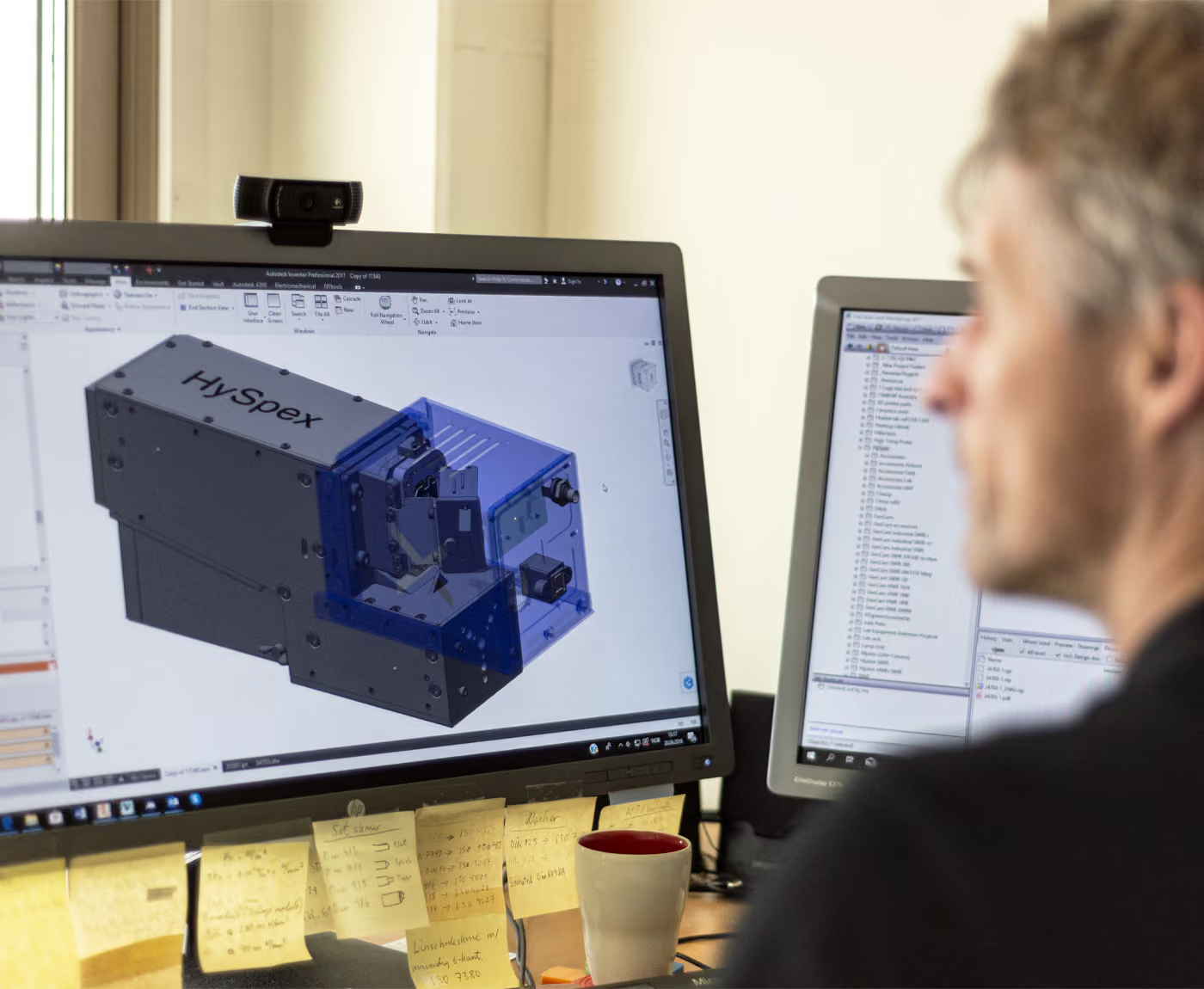

If you are researching hyperspectral imaging camera price, the most important thing to know is that hyperspectral systems are not typically evaluated like standard machine vision cameras. A hyperspectral camera is often a long-term analytical instrument investment, and pricing depends on far more than a single hardware specification. HySpex itself describes a hyperspectral imaging system as a significant investment and emphasizes that buyers should look beyond basic datasheet values when comparing alternatives.
For that reason, the real question is often not simply how much does a hyperspectral imaging camera cost? but rather what is included, what performance is required, and what level of data quality is necessary for the application?
Why There Is No Simple Standard Price for a Hyperspectral Imaging Camera
A hyperspectral imaging camera price can vary widely depending on the intended use. Research-grade systems, industrial in-line setups, airborne configurations, UAV-integrated solutions, and complete turnkey platforms all have different hardware, software, and integration requirements. HySpex offers everything from standalone camera products to turnkey solutions that combine cameras, software, computing, and platform integration, which is one reason pricing is inherently application-dependent.
Unlike conventional imaging products, hyperspectral systems are also often configured around the user’s spectral range, spatial resolution, platform, throughput, and analysis workflow. That means two systems described broadly as “hyperspectral cameras” may differ significantly in cost because they solve very different technical problems.
What Influences Hyperspectral Imaging Camera Price?
Several factors have a direct impact on hyperspectral imaging camera price.
1. Spectral Range
One of the biggest pricing factors is the wavelength range the system needs to cover. HySpex offers systems spanning visible, near-infrared, and shortwave infrared ranges, and broader or more specialised spectral coverage generally means more demanding optical, detector, and calibration requirements.
2. Spatial and Spectral Resolution
Higher spatial resolution and finer spectral detail often increase system complexity. In hyperspectral imaging, these performance factors are tied not only to sensor format, but also to optics, point spread function behavior, signal-to-noise performance, and sampling quality. HySpex’s own buyer guidance stresses that top-level specifications alone are not enough to describe how well a system actually performs.
3. Optical Quality and Calibration
A lower-priced system may appear comparable on paper, but data quality can differ substantially depending on optical sharpness, distortions, stray light, stability, and calibration traceability. HySpex repeatedly highlights scientific-grade quality factors such as sharp optics, low distortions, low stray light, high throughput optics, and stable traceable calibration as essential differentiators in real-world use.
4. System Type: Camera Only or Complete Solution
A hyperspectral imaging camera price may refer to a camera unit alone, but many users actually need a broader system. Turnkey solutions can include onboard or rack-mounted computing, acquisition software, touch-screen control, IMU/GPS integration, accessories, and application-specific configuration. HySpex explicitly markets complete turnkey solutions for airborne, field, industrial, laboratory, and UAV use cases.
5. Application Environment
Pricing is also shaped by where and how the system will operate. A laboratory setup, a field system, an industrial conveyor-based installation, and an airborne payload all require different design priorities. Industrial systems may prioritize line speed, repeatability, triggering, and integration, while airborne systems may require low mass, low power consumption, navigation integration, and robust performance under operational conditions.
6. Software and Analysis Workflow
For many buyers, the real value of the system depends on the software ecosystem as much as the sensor itself. Data acquisition, modelling, classification, quantification, and real-time deployment all influence the total solution cost. HySpex positions its processing software offering as part of a broader workflow from research and application development to real-time industrial analysis.
Why Comparing Price Alone Can Be Misleading
One of the clearest themes in HySpex’s buyer guidance is that comparing systems only by price or by simple headline specifications can lead to poor decisions over time. Their buyer’s guide notes that many users have deep expertise in spectroscopy or data analysis but limited experience with hyperspectral instrument hardware, and that lack of standardized comparison methods can make price seem like the easiest discriminator even when it may not reflect long-term value.
This is especially important because hyperspectral systems are often used for years and may become central to scientific work, industrial classification models, quality control workflows, or remote sensing programs. In that context, performance stability, calibration quality, and usable data often matter more than the lowest initial purchase price.
Hyperspectral Camera Cost in Research vs Industrial Use
The expected hyperspectral imaging camera price also depends on whether the system is being selected for research or production.
In research environments, buyers often prioritize:
- broad spectral capability
- high spatial and spectral fidelity
- low noise
- optical sharpness
- long-term measurement consistency
In industrial environments, priorities often include:
- speed
- repeatability
- robust triggering
- system integration
- scalable deployment
- reliable performance under production conditions
HySpex’s Baldur line is positioned specifically around industrial requirements such as speed, repeatability, reliability, light sensitivity, and flexible configuration, while other camera lines support field, laboratory, and airborne applications.
What Should Be Included in a Price Evaluation?
When evaluating hyperspectral imaging camera price, it is useful to ask what the quoted system actually includes.
A serious comparison may need to account for:
- camera hardware
- optics or close-up optics
- spectral range
- calibration level
- acquisition software
- analysis or modelling software
- computing hardware
- integration accessories
- platform-specific components such as navigation systems
- support, setup, and training
This matters because two solutions can differ substantially in quoted price simply because one is a camera-only configuration and the other is a more complete operational system.
How to Think About Value Instead of Just Cost
For many organisations, the more useful decision framework is not the lowest hyperspectral imaging camera price, but the best fit between:
- application needs
- data quality requirements
- deployment environment
- workflow maturity
- long-term usability
A lower-cost option can become more expensive over time if it produces unreliable models, poor classification performance, unstable calibration, or data that cannot support the intended analytical goals. Conversely, a well-matched system can provide better operational value even if the initial purchase price is higher.
Hyperspectral Imaging Camera Price Depends on the Full Application Context
In practice, there is no single universal answer to hyperspectral imaging camera price. The total cost depends on whether the system is intended for laboratory research, industrial sorting, food inspection, field deployment, airborne mapping, or UAV integration, and on how much performance, software, and integration support the user needs.
That is why price should be evaluated together with optical quality, calibration, spectral range, software workflow, and platform requirements. For advanced users, the best purchasing decisions usually come from understanding the full measurement task — not just comparing product labels or top-level specs.
Discuss Your Hyperspectral System Requirements
The right hyperspectral imaging camera depends on more than budget alone. Spectral range, spatial performance, calibration, software, and integration requirements all influence the most suitable system configuration.
HySpex provides hyperspectral imaging solutions for laboratory, field, industrial, airborne, and UAV applications, ranging from camera products to integrated turnkey systems.
If you are evaluating hyperspectral imaging camera price for a specific use case, a technical discussion about system requirements is often the best starting point.
FAQ – Hyperspectral Imaging Camera Price
How much does a hyperspectral imaging camera cost?
There is no single standard price. Hyperspectral imaging camera price depends on spectral range, optical quality, calibration, software, integration level, and application requirements. Research, industrial, airborne, and UAV systems can differ significantly in total cost.
Why are hyperspectral imaging systems expensive?
Hyperspectral systems are advanced analytical instruments, not just standard cameras. Their cost reflects demanding optical design, detector performance, calibration, software workflows, and, in many cases, complete integration into laboratory, industrial, or remote sensing platforms.
Does the quoted price usually include software?
Not always. In many cases, the total solution may include acquisition software, analysis tools, processing workflows, or complete turnkey integration. Buyers should clarify exactly what is included in the quoted system.
What affects hyperspectral imaging camera price the most?
Major pricing factors include spectral range, spatial and spectral resolution, optical quality, calibration, integration requirements, software, and whether the solution is camera-only or turnkey.
Is the cheapest hyperspectral camera the best value?
Not necessarily. HySpex’s buyer guidance explicitly warns that headline specifications and price alone may not reflect real performance or long-term usefulness. Data quality, stability, and fit to the application often matter more than the lowest initial price.