
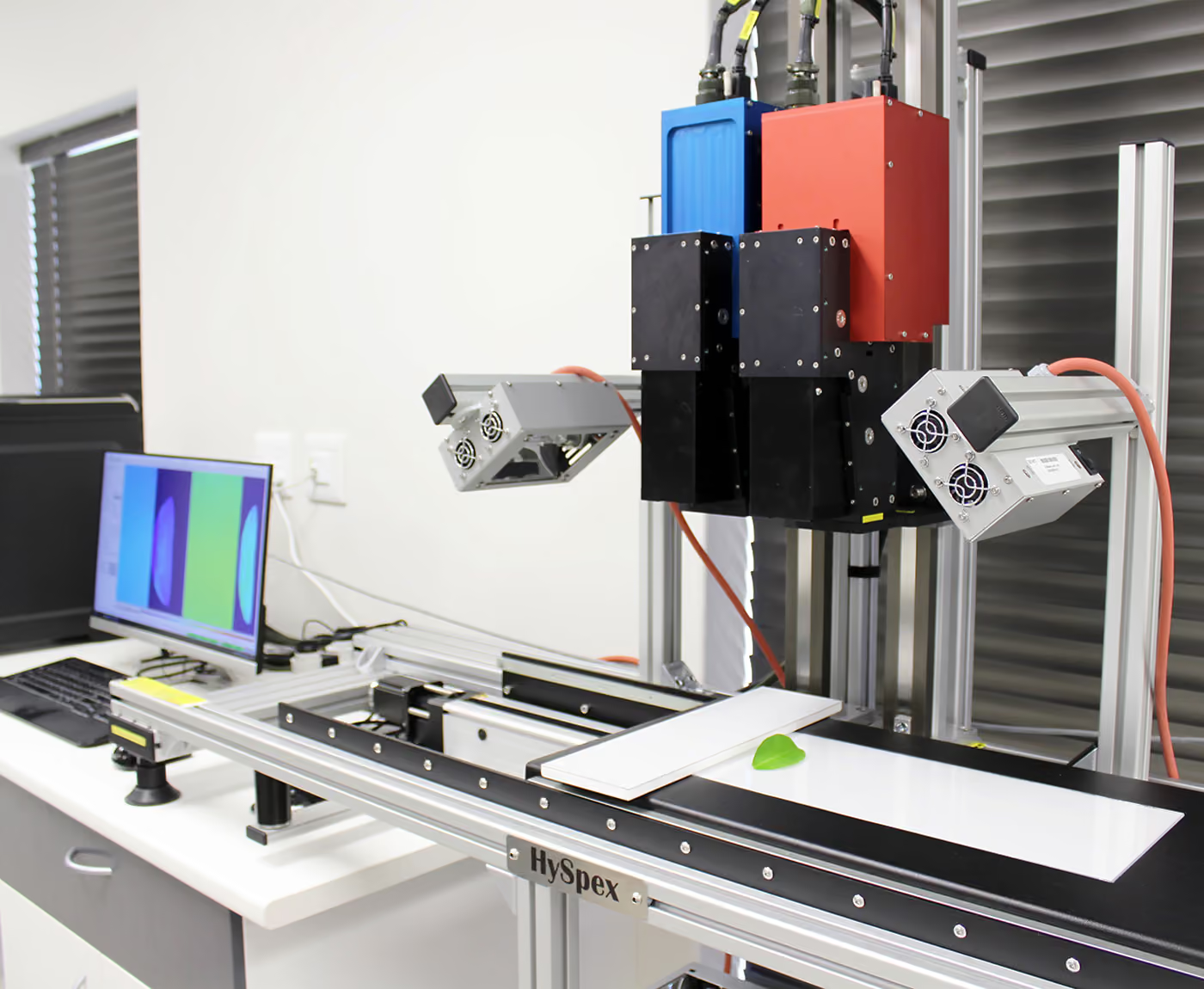

Hyperspectral imaging applications span a remarkable breadth of scientific, industrial, and remote sensing fields. By combining imaging and spectroscopy, hyperspectral systems provide detailed spectral information for every pixel in a scene, enabling materials to be detected, classified, and quantified based on their optical properties rather than visual appearance alone. From laboratory measurements to airborne missions and industrial production lines, the uses of hyperspectral imaging continue to expand as sensor technology, computing power, and data analysis tools mature.
For readers new to the field, our overview of what hyperspectral imaging is covers the underlying principles, and our introduction to spectral photos explains how spectral images differ from conventional photography. This article provides a comprehensive overview of where hyperspectral imaging is used, how it is deployed across different operational environments, and what kinds of integrated hyperspectral imaging solutions are available for different application contexts. Whether you are exploring hyperspectral imaging for a specific industry or evaluating system options for a new project, the sections below provide the structured starting point.
Quick Navigation
Application Verticals:
- Mining and Mineral Exploration
- Food Quality and Production
- Agriculture, Vegetation, and Forestry
- Industrial Sorting, Recycling, and Quality Control
- Pharmaceuticals and Powder Analysis
- Defence, Surveillance, and ISR
- Environmental Monitoring and Methane Detection
- Medical and Biomedical Research
- Cultural Heritage and Art Conservation
- Remote Sensing and Earth Observation
Solutions:
Why Hyperspectral Imaging Is So Versatile
The breadth of hyperspectral imaging applications comes from a single underlying capability: the ability to capture a continuous spectrum at every pixel in a scene. Many materials exhibit unique reflection and absorption features across visible, near-infrared (VNIR), and shortwave infrared (SWIR) wavelengths — and beyond, into the mid-wave and long-wave infrared. Hyperspectral systems can measure these subtle spectral signatures, enabling analysis that is not possible with conventional imaging.
Because hyperspectral data links spatial information with spectral measurement, the technology is suited both for mapping (identifying where something is in a scene) and for analytical tasks (identifying what something is). That combination is what makes hyperspectral imaging valuable across so many fields, from quality control on a conveyor belt to mineral mapping from an aircraft. Readers comparing hyperspectral imaging to other spectral techniques may also find our overview of hyperspectral vs multispectral imaging useful for understanding where each approach fits.
Hyperspectral Imaging Across Industry Verticals
The sections below summarize the major application areas where hyperspectral imaging is used today. Each links to dedicated articles and use case studies that go deeper into the specific applications and HySpex's role in each field.
Mining and Mineral Exploration {#mining}
Hyperspectral imaging supports the full mining workflow — from regional exploration and prospecting to drill core analysis, mine face mapping, and ore processing. Minerals exhibit characteristic absorption features across the VNIR and SWIR ranges, making spectral imaging a powerful tool for non-destructive mineral identification, alteration mapping, and lithological discrimination.
Specific applications include:
- Drill core scanning with the HySpex Core Scanner for high-throughput mineralogical mapping
- Mine face mapping in open-pit operations to identify alteration zones before extraction
- Exploration for critical minerals such as lithium, rare earth elements, and battery metals
- Identification of contamination and clay-rich zones to optimize material routing
- Regional exploration and prospecting using airborne and UAV-based spectral surveys
Notable deployments include the State of Alaska Geological Materials Center core logging system, developed in partnership with Telops to cover 400–12 500 nm in a single integrated platform.
Read more: Hyperspectral Imaging in Mining | Use cases: Mining, Lithology Mapping, Rare Earth Elements, Ore Distinction, Mine Waste Monitoring
Food Quality and Production {#food}
In the food industry, hyperspectral imaging supports quality control, contamination detection, freshness assessment, and grading. Spectral signatures can reveal moisture content, ripeness, internal defects, and biochemical composition that conventional imaging cannot. Applications include:
- Sorting and grading on high-throughput production lines
- Contamination and parasite detection in seafood and other products
- Freshness and quality assessment of perishable goods
- Research on food quality parameters and process optimization
HySpex's custom Fish Quality Analyzer, developed in collaboration with Nofima, Maritech, Lerøy, and Havfisk, is a representative example of how hyperspectral imaging is being integrated into food processing workflows. Use case studies cover everything from tomato and berry grading to cocoa bean quality assessment and parasite detection in fish.
Read more: Hyperspectral Imaging in Food Industry | Use cases: Tomato Quality Grading, Quality Control – Berries, Cocoa Beans Quality, Parasites in Fish
Agriculture, Vegetation, and Forestry {#agriculture}
Hyperspectral imaging is widely used in agriculture and forestry for crop monitoring, vegetation analysis, species identification, and plant phenotyping. Vegetation has strong, well-studied spectral signatures across the VNIR and SWIR, supporting:
- Chlorophyll content and photosynthetic activity assessment
- Water status and drought stress detection
- Disease identification and crop health monitoring
- Species classification and forest composition mapping
- Plant phenotyping for breeding and plant science research
UAV-mounted HySpex Mjolnir systems are particularly relevant for field-scale crop and forestry analysis, providing scientific-grade spectral data with operational flexibility. For controlled research environments, the HySpex Phenotyper custom solution supports plant breeding and plant science research with full-plant spectral scanning.
Read more: Hyperspectral Agriculture | Use cases: Forestry Management
Industrial Sorting, Recycling, and Quality Control {#industrial}
Industrial environments are one of the fastest-growing areas for hyperspectral imaging uses. Systems are integrated directly into production lines to monitor materials in real time, supporting automated sorting, contamination detection, and process monitoring.
Typical applications include:
- Textile sorting and fiber classification
- Plastic recycling and polymer identification
- Paper recycling and contamination detection
- Steel and cement production monitoring
- Coating thickness measurement
- Thin film analysis
- Real-time chemical and material identification on conveyor belts
The HySpex Baldur series — designed specifically for industrial deployment, with NIST and PTB-traceable calibration, multiple regions of interest, and external triggering options — combined with Prediktera Breeze Runtime software, provides the integrated platform for these workflows. Our overviews of hyperspectral software and hyperspectral image data cover the broader analytical and data-handling layer that makes industrial deployment work.
Use cases: Textile Sorting, Mixed Plastic Waste, Paper Recycling, Steel Casting Brick Products, Cement Rotary Kilns, Thin Films, Coating Thickness, Compostable Plastics, Asbestos
Pharmaceuticals and Powder Analysis {#pharma}
Pharmaceutical formulation, powder analysis, and chemical quantification are well-established hyperspectral imaging applications. SWIR spectroscopy is particularly powerful for distinguishing chemical compositions, mapping active ingredient distribution, and identifying contaminants in powdered materials.
Applications include:
- Tablet and capsule inspection
- Powder mixture homogeneity analysis
- Active ingredient distribution mapping
- Raw material identification and incoming quality control
- Process monitoring in pharmaceutical manufacturing
- Carbonate and mineral quality assessment in raw materials
The combination of high-throughput acquisition with the analytical depth of Prediktera Software Suite supports both research workflows and production-scale deployment.
Use cases: Analysis of Pharmaceuticals, Powder Analysis, Powders Carbonate Quality, Carbonate Quality
Defence, Surveillance, and ISR {#defence}
Defence and surveillance use cases include:
- Camouflage, concealment, and deception detection
- Target identification and material discrimination
- Intelligence, surveillance, and reconnaissance (ISR)
- Mine and improvised explosive device detection
- Chemical agent and plume detection
- Border monitoring and critical infrastructure protection
HySpex has deep roots in this domain — Norsk Elektro Optikk was founded in 1985 by researchers from the Norwegian Defence Research Establishment (FFI), and the company participates in European defence research programs such as the EDA Hyper-IP project. Most operational defence and ISR systems use scanning pushbroom architectures rather than snapshot hyperspectral cameras, because the calibration stability and spectral fidelity required for operational use are easier to achieve with scanning systems.
The dedicated HySpex Mjolnir OEM systems are purpose-built for ISR platforms, with a navigation system supporting optional GNSS-denied capability and full compatibility with HySpex Bifrost real-time processing software for on-board analytics.
Read more: Hyperspectral Imaging Military Applications and Surveillance | Use cases: Explosives
Environmental Monitoring and Methane Detection {#environmental}
Hyperspectral imaging supports environmental monitoring across a wide range of applications, including:
- Vegetation and ecosystem health assessment
- Methane emissions detection and quantification
- Atmospheric gas and pollutant monitoring
- Water quality and aquatic ecosystem assessment
- Soil composition and contamination mapping
- Long-term environmental change studies
Methane detection has become a particularly active area, with HySpex contributing to ESA's InCubed program through the development of a satellite-based hyperspectral camera dedicated to methane monitoring. For ground-based environmental monitoring, the HySpex Mjolnir IP65 custom solution supports unattended operation in exposed remote locations over extended periods.
Use cases: Methane Emissions, Airborne Methane Detection
Medical and Biomedical Research {#medical}
Hyperspectral imaging is an active area of research in medical and biomedical fields, with investigation across:
- Wound and burn assessment using tissue oxygenation and perfusion mapping
- Surgical guidance and tumor margin analysis
- Dermatology research including skin lesion and pigmentation studies
- Ophthalmology and retinal oxygenation analysis
- Endoscopic and minimally invasive imaging research
The technology provides non-contact spectral measurement of tissue properties — oxygenation, perfusion, composition — that conventional imaging cannot reveal directly. Clinical adoption of these techniques remains predominantly investigational, with research-grade hyperspectral systems supporting the validation and translation work that may eventually lead to broader clinical use. HySpex's role in this space is as a provider of the imaging foundation that researchers and clinical investigators build upon.
Read more: Hyperspectral Medical Imaging, Hyperspectral Imaging Medical Applications
Cultural Heritage and Art Conservation {#heritage}
One of the most distinctive hyperspectral imaging uses is in cultural heritage and art conservation. The HySpex Art Scanner, originally developed in 2011 for the Louvre's Centre for Research and Restoration of the Museums of France (C2RMF), is used by museums and conservation experts worldwide to reveal hidden features, map pigments, and document artworks non-invasively. Researchers from the Norwegian Colour and Visual Computing Laboratory at NTNU have used the Art Scanner to carry out pigment mapping of Edvard Munch's The Scream.
Beyond paintings, hyperspectral imaging supports monument preservation, building conservation, and material degradation studies.
Use cases: Monument Preservation
Remote Sensing and Earth Observation {#remote-sensing}
Airborne and satellite-based hyperspectral remote sensing supports applications across:
- Large-scale vegetation monitoring and forest health assessment
- Geological mapping and mineral exploration over wide areas
- Environmental assessment and change detection
- Terrain analysis and land cover classification
- Earth observation and climate-related monitoring
HySpex's airborne systems have flown on platforms ranging from light aircraft to UAVs to stratospheric platforms (with Sceye), and the company's space heritage extends from the 1995 HISS project for ESA through current satellite mission contributions. For combined active and passive sensing scenarios, our overview of hyperspectral LiDAR covers an emerging area that combines hyperspectral imaging with LiDAR-based ranging.
Read more: Hyperspectral Remote Sensing Systems | Use cases: Cuprite Benchmark Campaign
Hyperspectral Imaging Solutions — How Systems Are Configured
Beyond the individual applications, the practical deployment of hyperspectral imaging depends on how the system is configured for the operational environment. HySpex offers two main paths: turnkey solutions for established deployment configurations, and custom solutions for applications where standard configurations need adaptation. These together form the operational layer between the underlying hyperspectral cameras and the specific application.
Turnkey Hyperspectral Imaging Solutions {#turnkey}
Turnkey solutions are integrated, ready-to-deploy hyperspectral imaging systems configured for one of five standard operational environments:
Laboratory Systems integrate HySpex cameras with translation stages, lab racks, full-range light sources, and acquisition software for controlled scanning of static scenes in laboratory, field, and clinical environments. Suited to research, materials analysis, and biomedical investigation.
Field Systems combine cameras with tripods, rotation stages, battery-powered acquisition units, and portable accessories for outdoor scientific work. Multiple tripod and rotation stage options support different field scenarios, from terrain mapping to mine face scanning.
Airborne Systems provide complete integrated platforms for aircraft and UAV deployment. Standard configurations include IMU/GPS navigation systems, high-performance rack computers, vibration-damped mounts, and dedicated airborne software with touchscreen operation.
UAV Systems are dedicated drone-compatible bundles built around the HySpex Mjolnir series, combining the hyperspectral camera with a PicoITX i7 computer and an Applanix APX-15 navigation system in a single self-contained module. The Mjolnir is positioned as a generic payload, integrating onto any UAV with sufficient lift capacity.
Industrial Systems combine the HySpex Baldur series with Prediktera Breeze software for real-time material sorting, contamination detection, and quality control on production lines. Baldur cameras provide NIST and PTB-traceable calibration, multiple regions of interest, external triggering (TTL, LVDS), and approximately four times the light sensitivity of the Classic series.
Custom Hyperspectral Imaging Solutions {#custom}
For applications where standard turnkey configurations do not fit, HySpex develops Custom Solutions tailored to specific operational requirements. Five named custom solutions are currently in active deployment:
HySpex Core Scanner for drill core analysis in mining and geology, combining VNIR and SWIR cameras with Prediktera Breeze Geo software for real-time mineralogical mapping.
HySpex Art Scanner for cultural heritage and art conservation, with horizontal and vertical scanning stages supporting paintings up to 1.9 by 2 meters at working distances from 30 centimeters and spatial resolutions to approximately 12 micrometers.
HySpex Fish Quality Analyzer for inspection of fish fillets and round fish, developed in collaboration with Nofima, Maritech, Lerøy, and Havfisk.
HySpex Phenotyper for plant phenotyping research, scanning the full length of plants up to 2 meters with combined horizontal and vertical scanning stages.
HySpex Mjolnir IP65 for unattended outdoor monitoring in exposed remote locations, with IP65-rated environmental protection on the camera and an IP67-graded FLIR pan/tilt head for continuous operation over extended periods.
For applications outside these named solutions, HySpex develops bespoke configurations on a project basis — the company is explicitly recognized for delivering custom solutions for unconventional applications.
The Imaging Foundation Across All Solutions
All HySpex solutions are built on three core hyperspectral camera families: the HySpex Classic series for scientific-grade general-purpose imaging, the HySpex Mjolnir series for compact UAV and field deployment, and the HySpex Baldur series for industrial production environments. These cameras share the underlying pushbroom architecture, traceable calibration, and engineering disciplines that define HySpex's positioning in scientific-grade hyperspectral imaging. Our overviews of hyperspectral sensors and hyperspectral cameras and imagery cover the detector technology and camera-level perspective in more depth.
System Quality Across Applications and Solutions
Across all of these hyperspectral imaging applications and solutions, system quality determines whether the data is actually useful. The factors detailed in the HySpex Key Quality Parameters resources — spectral fidelity, low optical distortions, calibration stability, signal-to-noise ratio, and proper Nyquist sampling — all influence what can be reliably measured.
These considerations matter more in some applications than others. Quantitative mineralogy depends on subtle absorption features that disappear in noisy data. Cultural heritage analysis depends on calibration stability across years of work. Industrial quality control depends on repeatability across shifts and across multiple installed systems. The right system specification is the one matched to the actual demands of the application, not the one with the highest headline numbers.
For organisations evaluating hyperspectral imaging for the first time, the HySpex Buyer's Guide provides a structured starting point for thinking through these trade-offs.
Where Hyperspectral Imaging Is Heading
The breadth of hyperspectral imaging uses continues to expand as sensor technology matures, data processing improves, and integration with machine learning and analytical workflows becomes more sophisticated. What was once primarily a research tool is now an operational technology in industry, environmental monitoring, defence, and remote sensing.
For HySpex specifically, this means continued investment in scientific-grade imaging technology that supports both well-established applications and emerging ones — from drill core scanning that has been a flagship for over a decade to UAV-based platforms that are still expanding the range of feasible deployments.
Discuss Hyperspectral Imaging Applications and Solutions for Your Field
The right hyperspectral imaging solution depends on the materials, the operational environment, the analytical requirements, and how the data needs to integrate with your broader workflow. From laboratory research to industrial integration, airborne remote sensing, and custom application-specific systems, the configurations available today cover a wide range of needs.
HySpex develops scientific-grade hyperspectral imaging cameras, turnkey systems for laboratory, field, airborne, UAV, and industrial deployment, and custom solutions for applications that need bespoke configuration. If your project involves advanced material analysis, classification, or spectral measurement, a technical discussion about your specific requirements is often the best starting point. For an introduction to pricing considerations, our overview of hyperspectral imaging camera price covers the factors that influence cost across system types. Feel free to contact us for more information.
FAQ – Hyperspectral Imaging Applications, Uses, and Solutions
What are the main applications of hyperspectral imaging?
Hyperspectral imaging applications span industrial inspection, environmental monitoring, geological analysis, scientific research, defence and surveillance, cultural heritage, biomedical research, and airborne remote sensing. The technology is used wherever detailed spectral information is required to identify, classify, or quantify materials based on their optical properties rather than visual appearance alone.
What is the difference between hyperspectral imaging uses and applications?
The terms are largely interchangeable in practice. "Hyperspectral imaging uses" tends to describe operational deployment scenarios — laboratory analysis, industrial sorting, airborne mapping — while "applications" tends to describe the specific tasks the technology performs, such as mineral identification, vegetation analysis, or quality control. Both terms cover the same range of activities.
What are hyperspectral imaging solutions?
Hyperspectral imaging solutions are integrated systems that combine hyperspectral cameras with the surrounding hardware, software, and accessories needed to deploy the technology for a specific environment or application. They are typically organised as turnkey solutions for standard deployment configurations or as custom solutions for specialised applications.
What turnkey hyperspectral imaging solutions does HySpex offer?
HySpex offers five turnkey deployment configurations: Laboratory Systems, Field Systems, Airborne Systems, UAV Systems, and Industrial Systems. Each integrates HySpex hyperspectral cameras with the supporting hardware, software, and accessories suited to that operational environment.
What custom hyperspectral imaging solutions does HySpex offer?
HySpex develops custom solutions for specialised applications. Five named custom solutions are currently in active deployment: the HySpex Core Scanner for drill core analysis, the HySpex Art Scanner for cultural heritage and art conservation, the HySpex Fish Quality Analyzer for seafood quality inspection, the HySpex Phenotyper for plant phenotyping research, and the HySpex Mjolnir IP65 for unattended outdoor environmental monitoring. Bespoke configurations for other applications are developed on a project basis.
How is hyperspectral imaging used in industry?
In industrial settings, hyperspectral imaging is used for material sorting, contamination detection, process monitoring, chemical quantification, and quality control. Systems are integrated directly into production lines, often using conveyor belt motion as the scan dimension, with real-time analysis through software platforms such as Prediktera Breeze Runtime. The HySpex Baldur series is purpose-designed for these industrial environments.
How is hyperspectral imaging used in remote sensing?
In remote sensing, hyperspectral imaging supports vegetation analysis, mineral mapping, environmental assessment, terrain studies, and an expanding range of Earth observation tasks. Airborne, UAV, and satellite-based systems allow large areas to be surveyed with high spectral detail. Integration with IMU/GPS navigation systems enables accurate georeferencing of the resulting data.