

Hyperspectral agriculture refers to the use of hyperspectral imaging technology to analyze crops, vegetation, and agricultural environments. By measuring light across many narrow wavelength bands, hyperspectral systems provide detailed information about plant condition, soil properties, and field variability that cannot be seen with standard imaging.
Hyperspectral imaging for agriculture transforms fields into measurable spectral datasets, enabling more precise monitoring, research, and decision-making.
Why Hyperspectral Imaging Is Valuable in Agriculture
Plants interact with light in complex, wavelength-dependent ways. Subtle changes in pigments, water content, cell structure, and biochemical composition all affect how leaves and crops reflect and absorb light.
A hyperspectral imaging system captures this information as a continuous spectrum for each pixel. This allows:
- Detection of plant stress before visible symptoms appear
- Differentiation between crop types or growth stages
- Quantification of moisture and biochemical properties
- Identification of variability within a field
Because the technology links spatial and spectral information, it supports both mapping and detailed analysis.
Spectral Regions Relevant for Agricultural Applications
Hyperspectral imaging systems used in agriculture often operate across the visible, near-infrared (VNIR), and shortwave infrared (SWIR) ranges.
- Visible wavelengths are sensitive to pigments such as chlorophyll.
- Near-infrared wavelengths provide information about leaf structure and biomass.
- Shortwave infrared wavelengths are strongly influenced by water and certain biochemical components.
By combining these regions, hyperspectral imaging for agriculture can reveal plant properties that are not accessible through conventional color or multispectral cameras.
Airborne and UAV-Based Hyperspectral Agriculture
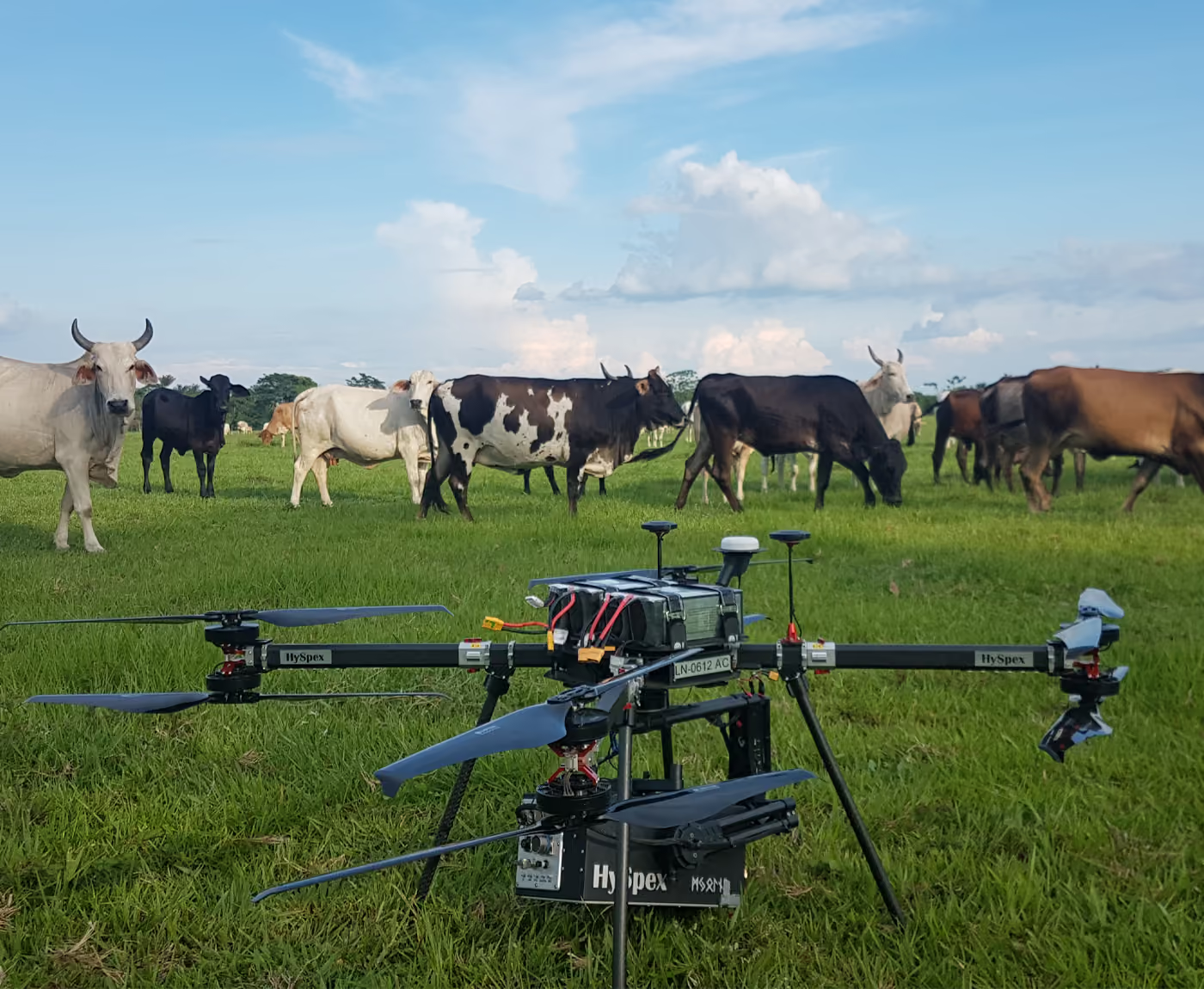
Airborne and UAV platforms are key tools in hyperspectral agriculture. Mounted on aircraft or drones, hyperspectral sensors collect data across entire fields with high spatial and spectral resolution.
Lightweight hyperspectral systems designed for UAV deployment enable:
- Field-scale crop monitoring
- Assessment of spatial variability
- Support for research trials and precision farming studies
Integration with navigation systems such as IMU and GPS allows hyperspectral data to be accurately georeferenced, linking spectral measurements to precise locations in the field.
Compact UAV Hyperspectral Systems for Agricultural Sensing
Recent developments in compact hyperspectral imaging systems have made UAV-based agricultural sensing increasingly practical. Lightweight systems such as the HySpex Mjolnir series combine a small form factor with scientific-grade spectral performance, enabling deployment on high-performance drones. Integrated solutions that combine onboard computing and navigation enable flexible field operations while maintaining the spectral precision required for research-driven vegetation and crop studies.
Field Measurements and Ground Validation
In addition to airborne sensing, field-based hyperspectral systems are used for detailed measurements close to crops and soil. Tripod-mounted setups with controlled scanning allow researchers to collect high-resolution spectral data in natural conditions.
These field measurements are important for:
- Calibrating airborne or UAV datasets
- Studying plant response under controlled experiments
- Developing and validating spectral models
Portable field configurations support flexible deployment across different agricultural environments.
Hyperspectral Imaging for Crop Research and Analysis
Many applications of hyperspectral imaging for agriculture are research-driven. Scientists use hyperspectral data to study plant physiology, stress responses, and environmental effects.
Typical research uses include:
- Monitoring vegetation health
- Studying water stress and nutrient status
- Analyzing plant biochemical properties
- Investigating crop performance under varying conditions
High spectral resolution and stable calibration are essential when hyperspectral imaging is used as a quantitative research tool.
Data Analysis and Modeling in Agricultural Applications
Collecting hyperspectral data is only the first step. Software tools are used to process images, develop models, and extract meaningful parameters related to crop and soil properties.
Hyperspectral software platforms support:
- Visualization of spectral signatures
- Development of classification and regression models
- Application of spectral libraries
- Integration of results into broader research or operational workflows
This combination of sensors and software enables hyperspectral imaging to function as an analytical technology in agricultural studies.
Hyperspectral Agriculture as a Growing Field
As sensing technologies evolve, hyperspectral imaging is becoming an increasingly important tool in agricultural research and advanced field monitoring. By providing detailed spectral insight into vegetation and soil, hyperspectral agriculture supports more precise understanding of plant and environmental processes.
Rather than relying solely on visual inspection, hyperspectral imaging enables agriculture-related studies to be based on measurable optical properties, supporting improved analysis and more informed decisions.
Apply Hyperspectral Imaging to Agricultural and Vegetation Studies
Using hyperspectral imaging for agriculture requires careful consideration of spectral range, spatial resolution, platform choice, and data analysis workflows. From UAV-based surveys to detailed field measurements, system configuration depends on the scale and objectives of the study.
HySpex hyperspectral imaging systems are used in research, environmental monitoring, and field-based spectral analysis where stable, high-quality data is essential. Our team works with researchers and technical users to evaluate sensor performance, platform integration, and data processing approaches for vegetation and field applications.
If your work involves crop analysis, vegetation monitoring, or field-based spectral research, we can provide guidance on suitable hyperspectral imaging system configurations. Please contact us for more information.
FAQ – Hyperspectral Agriculture
What is hyperspectral agriculture?
Hyperspectral agriculture refers to the use of hyperspectral imaging technology to study crops, vegetation, and soil. It enables analysis of plant properties based on spectral signatures rather than only visual appearance.
How is hyperspectral imaging used in agriculture?
Hyperspectral imaging for agriculture is used to monitor crop health, detect plant stress, study water content, and analyze vegetation properties. It is commonly applied in research and advanced field monitoring.
Why is spectral range important in agricultural applications?
Different plant characteristics affect light differently across visible, near-infrared, and shortwave infrared wavelengths. A broad spectral range allows more detailed analysis of pigments, structure, and moisture.
Can hyperspectral imaging be used from UAVs in agriculture?
Yes. UAV-mounted hyperspectral systems are widely used to collect high-resolution spectral data across fields. These systems support mapping and monitoring of vegetation and crop variability.
Is hyperspectral imaging mainly for research in agriculture?
Currently, hyperspectral imaging in agriculture is strongly research-driven, but it also supports advanced monitoring and field studies where detailed spectral analysis is required.