
Geothermal Energy Research

Revealing the Subsurface Through Hyperspectral Imaging
Geothermal energy represents a sustainable and low-emission alternative to fossil fuels, but its development hinges on accurately mapping subsurface geological features.
Hyperspectral imaging, which captures detailed spectral data across a wide range of wavelengths, has proven particularly effective in geothermal studies. In the SWIR range (1300–2500 nm), the technology can identify key alteration minerals such as smectite, illite, chlorite, and other clays that serve as indicators of thermal gradients and fluid pathways. These minerals are critical for understanding subsurface temperature distribution and permeability, both essential factors in assessing geothermal potential.
A recent study at the Coso Geothermal Field in California was carried out within the Center to Advance the Science of Exploration to Reclamation in Mining (CASERM) at Colorado School of Mines, which is supported by the Industry-University Cooperative Research Centers program of the National Science Foundation. The study highlighted the power of SWIR hyperspectral imaging in geothermal exploration. The Coso Geothermal Field, one of the largest geothermal power sources in the United States, has a history of volcanic activity that has left a complex geological footprint. A HySpex hyperspectral SWIR-384 camera was used to analyze drill chips from five drill holes, generating a detailed downhole map of alteration mineralogy and thermal gradients (Al-Attar, 2024).
Mapping Alteration Zones and Thermal Gradients
Alteration minerals form as hot geothermal fluids interact with surrounding rocks, leaving behind distinct mineral assemblages that vary with temperature and fluid chemistry. Smectite, for example, is stable at temperatures up to 180°C, whereas illite forms at higher temperatures, often exceeding 225°C.
By identifying the spatial distribution of these minerals, hyperspectral imaging provides a proxy for subsurface temperature gradients. At the Coso Geothermal Field, this approach revealed a complex distributions of alteration minerals, suggesting multiple hydrothermal events and offering clues about the system's thermal history.
Enhancing Geothermal Exploration Efficiency
For geothermal companies, hyperspectral imaging delivers several advantages. The SWIR range excels at detecting molecular bonds (e.g., OH, H2O, AlOH, MgOH) that define many alteration minerals (Figure 1). This capability enables rapid, accurate mineral identification, even in mixed assemblages. In the Coso study, researchers used a HySpex SWIR-384 scanner with Prediktera Breeze Geo software to scan and analyze drill chips (Figure 2). Mineral identification used the USGS PRISM MICA routines providing objective classification of SWIR-active alteration minerals (Kokaly, 2011; Kokaly et al., 2017).
This streamlined workflow enables operators to:
♦️ Quickly identify alteration zones that indicate high-temperature reservoirs and upflow zones.
♦️ Construct detailed thermal gradient models to target productive areas.
♦️ Enhance subsurface modeling by pinpointing zones with high permeability and favorable thermal conditions.
Moreover, hyperspectral imaging enables a more extensive sampling approach, allowing for the analysis of full drill holes and adds value by supporting traditional sampling and geochemistry by providing a fast, reliable way to identify areas in the drill core for further sampling.
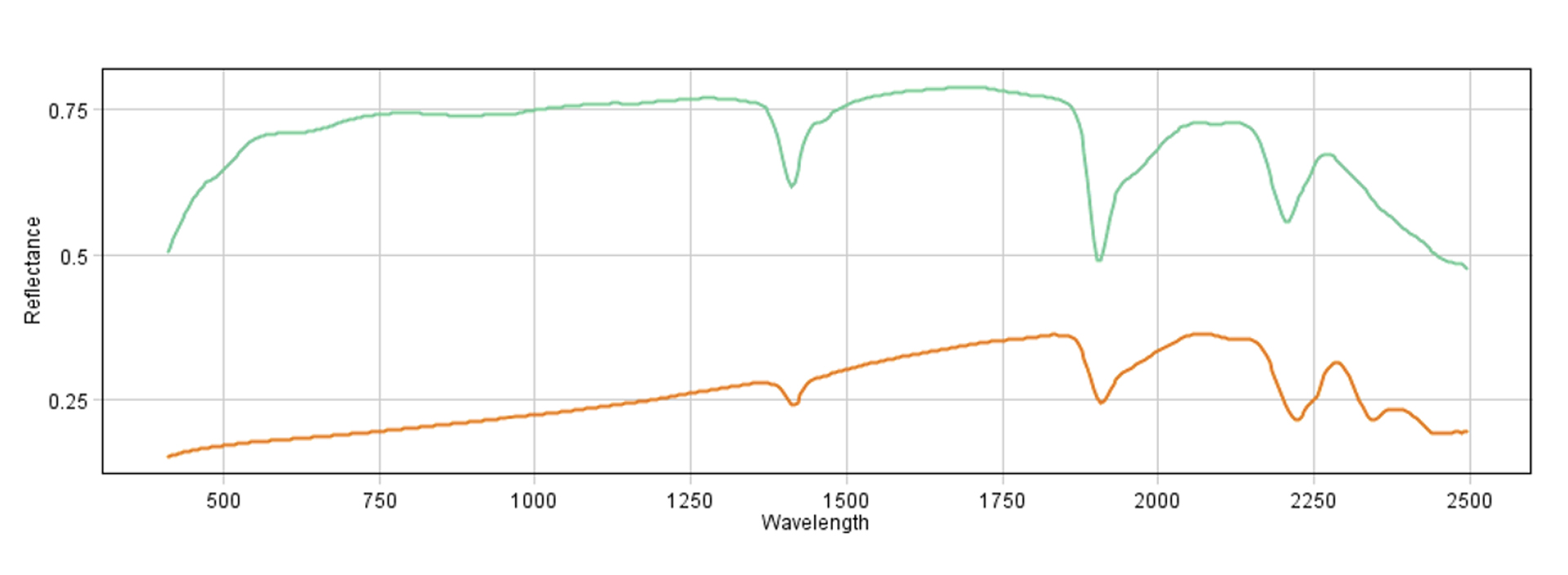
Figure 1: Montmorillonite (smectite, green) and illite (orange) spectra plotted within Breeze software. Wavelength in nanometers. Sample “Montmorillonite_Na_SWy-1” and “Illite GDS4 Marblehead” from USGS Spectral Library Version 7 (Kokaly et al., 2017).
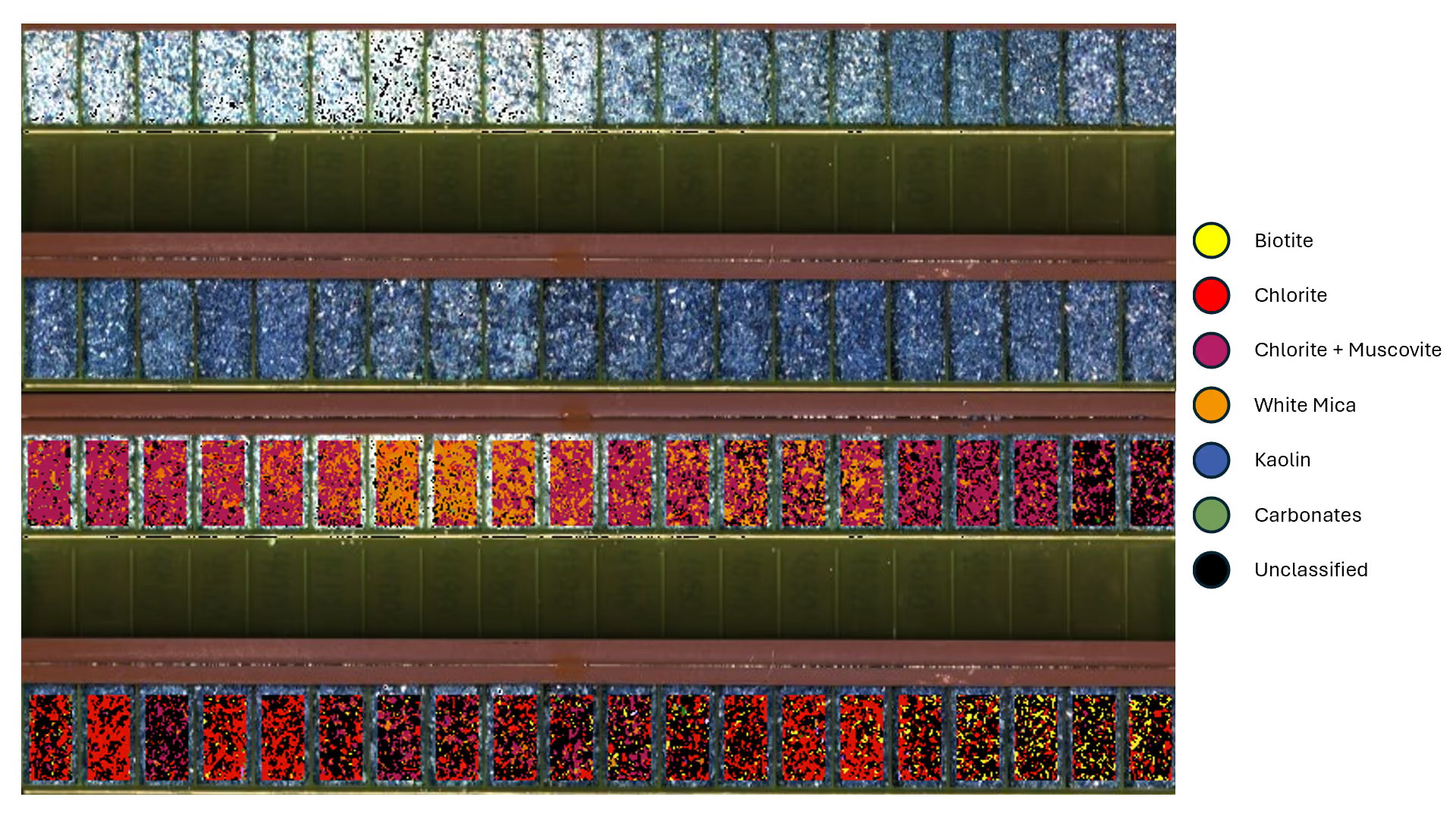
Figure 2: Drill chip analysis from the Coso Geothermal Field. Top: False-color RGB, scanned at 1.0m working distance achieving a 0.75 x 0.75 mm pixl resolution. Bottom: Mineral mapping based on USGS MICA classification.
Applications Beyond Mineral Mapping
The utility of hyperspectral imaging extends beyond alteration mineral mapping. By analyzing thermal gradients, companies can assess a geothermal system’s lifespan and sustainability. For example, the presence of smectite or illite-smectite at depths beyond their typical thermal stability suggests recent heating events, which may indicate ongoing geothermal activity. Such insights are invaluable for long-term resource management and efficient energy extraction.
As the demand for renewable energy grows, the need for innovative exploration techniques becomes more pressing, hyperspectral imaging via HySpex instruments provides a non-invasive way to add significant value to drill core analysis.
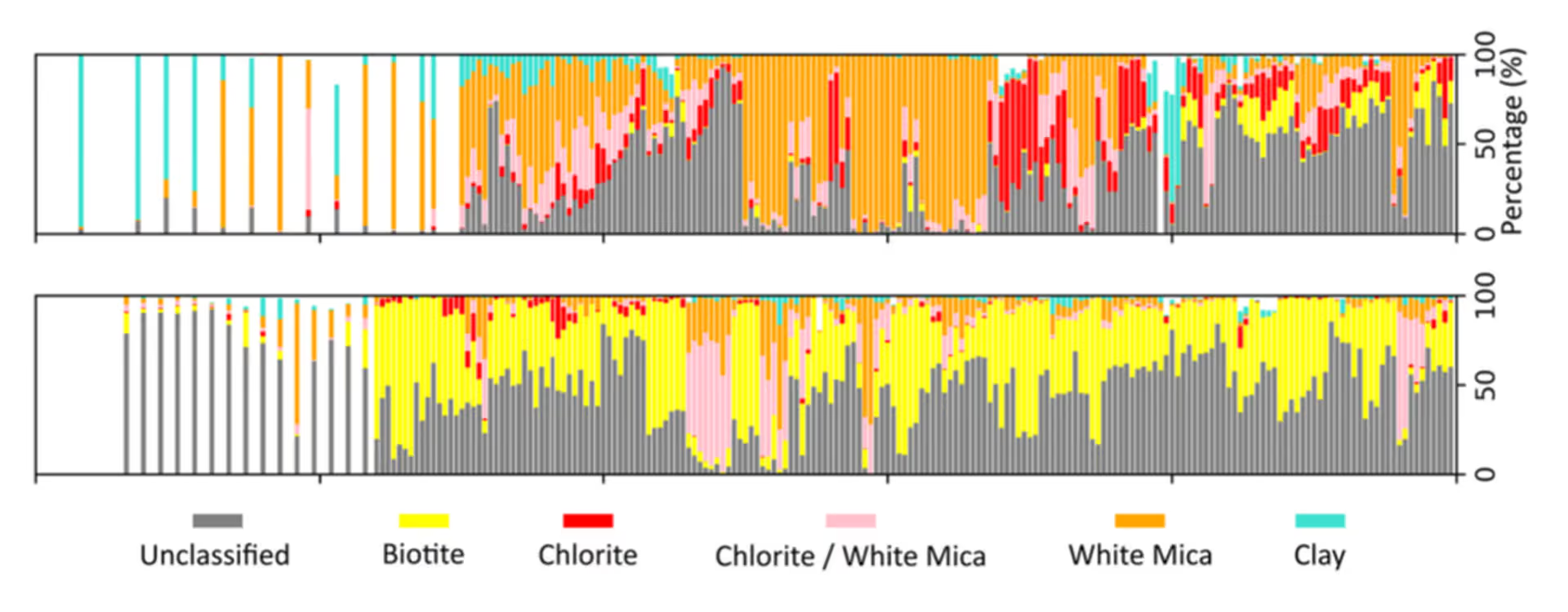
Figure 3: USGS Library mineral mapping results for two drill holes for the depth from the surface to 2500 ft depths.
Interested in learning more about how hyperspectral imaging can benefit your geothermal energy research?
Get in touch with one of our hyperspectral specialists by filling out a form on our contact page! We offer many turnkey solutions for mining and raw material-related studies as well as other scientific and industrial applications.
Sources:
- Al-Attar, Z., 2024. Unmanned aerial vehicle and laboratory-based hyperspectral imaging to unravelmodern and ancient hydrothermal systems. M.S. thesis, Colorado School of Mines
- Kokaly, R.F., 2011. PRISM: Processing routines in IDL for spectroscopic measurements. U.S. Geological Survey Open-File Report 2011-1155
- Kokaly, R.F., Clark, R.N., Swayze, G.A., Livo, K.E., Hoefen, T.M., Pearson, N.C., Wise, R.A., Benzel, W.M., Lowers, H.A., Driscoll, R.L., and Klein, A.J., 2017. USGS Spectral Library version 7. U.S. Geological Survey Data Series 1035
- Ungaro, F (2017) Gray chimney releasing smoke [Photograph]. Unsplash. https://unsplash.com/photos/gray-chimney-releasing-smoke-hqGfTe2Ri9s